Browse audiobooks by Aldous Huxley, listen to samples and when you're ready head over to Audiobooks.com where you can get 3 FREE audiobooks on us
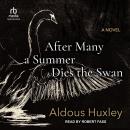
After Many a Summer Dies the Swan: A Novel
"A Hollywood millionaire with a terror of death, whose personal physician happens to be working on a theory of longevity—these are the elements of Huxley's caustic and entertaining satire on man's desire to live indefinitely. 'A highly sensational plot that will keep astonishing you to practically the final sentence.' —The New Yorker."
Aldous Huxley (Author), Robert Fass (Narrator)
Audiobook
"This haunting dystopian novel by Aldous Huxley presents a future where human life is engineered in laboratories, emotions are carefully regulated, and happiness is manufactured through science, conditioning, and chemical pleasure. From birth, every individual is designed to fit a predetermined role in a rigid social hierarchy where comfort replaces freedom and stability is valued above truth. Pain, suffering, deep love, and spiritual longing are treated as dangerous flaws, carefully erased in favor of distraction, consumption, and shallow contentment. Beneath the polished surface of this perfectly managed world lies a quiet and devastating loss—the loss of choice, struggle, and authentic feeling. Those who begin to sense what has been stolen from them face exile, isolation, or psychological collapse. Human connection is reduced to appetite, family is stripped of meaning, and art, faith, and history are dismissed as useless remnants of a chaotic past. What first appears to be a flawless paradise slowly reveals itself as a prison built not from chains, but from pleasure and obedience. The novel explores technology, conformity, desire, control, and the erosion of the human spirit. It is a powerful and disturbing warning about a future where tyranny no longer needs violence—because the people no longer remember what it means to resist."
Aldous Huxley (Author), Aldous Huxley, Alex Squire, The Light (Narrator)
Audiobook
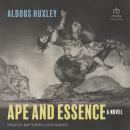
"When Aldous Huxley's Brave New World first appeared in 1932, it presented in terms of purest fantasy a society bent on self-destruction. Few of its outraged critics anticipated the onset of another world war with its Holocaust and atomic ruin. In 1948, seeing that the probable shape of his anti-utopia had been altered inevitably by the facts of history, Huxley wrote Ape and Essence. In this savage novel, using the form of a film scenario, he transports us to the year 2108. The setting is Los Angeles where a 'rediscovery expedition' from New Zealand is trying to make sense of what is left. From chief botanist Alfred Poole we learn, to our dismay, about the twenty-second-century way of life."
Aldous Huxley (Author), Matthew Lloyd Davies (Narrator)
Audiobook
Brave New World: With Rare Interviews
"Aldous Huxley’s Brave New World is one of the most unsettling and visionary works of the twentieth century—a chilling portrait of a future society that has traded freedom, individuality, and emotional depth for pleasure, stability, and total control. In this meticulously engineered world, human beings are not born but manufactured, conditioned from infancy to accept their predetermined roles, and pacified by constant entertainment and the euphoric drug soma. Pain has been eliminated, conflict erased, and truth replaced by sophisticated systems of distraction and propaganda designed to keep every citizen compliant and content. At the center of this controlled paradise is Bernard Marx, a man who secretly hungers for something more authentic—real emotion, genuine thought, and the freedom to question the world around him. His encounter with John, the so-called Savage who was raised outside the sleek machinery of the World State, sets off a mighty clash of values that exposes the terrifying emptiness beneath society’s perfect exterior. Through their stories, Huxley reveals the true cost of a world built on engineered happiness, technological domination, and the quiet surrender of the human soul. Brave New World remains startlingly relevant, offering a profound warning about the dangers of convenience without conscience, pleasure without purpose, and a society willing to sacrifice its humanity for the illusion of peace. It is a timeless meditation on what it means to feel deeply, think freely, and resist a world determined to design every aspect of existence. With a complete and complex life history of the author by Emmy-nominated actor and internationally heralded best-selling author Geoffrey Giuliano."
Aldous Huxley (Author), Aldous Huxley (Narrator)
Audiobook
"Mit gespenstischer Klarsicht nahm Aldous Huxley schon 1946 unsere Gegenwart vorweg: Durch technologischen Fortschritt konzentriert sich politische Macht plötzlich in den Händen weniger. In Zeiten gesellschaftlichen Umbruchs haben Nationalismus und geopolitische Machtspiele Hochkonjunktur, während Demokratie und Solidarität leiden. Stilistisch brillant beschreibt Aldous Huxley das aufziehende Zeitalter einer Tech-Oligarchie - einer Welt, in der Boy Gangsters in den Regierungen sitzen und das Recht des Stärkeren die Freiheit aller bedroht. Huxleys prophetische Intervention war 80 Jahre lang verschollen. Heute trifft sie mitten ins Mark."
Aldous Huxley (Author), Frank Arnold (Narrator)
Audiobook
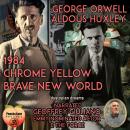
1984, Chrome Yellow, Brave New World
"In 1984 by George Orwell, one of the pivotal paragraphs that captures the essence of the novel is when Winston Smith reflects on the power and control exerted by the Party. This passage illustrates the Party's ability to manipulate reality and shape individual thought: 'Who controls the past controls the future; who controls the present controls the past.' This phrase encapsulates the totalitarian regime's grip on history and truth. By constantly rewriting records and altering facts, the Party ensures that they control not just the narrative of the past, but also how people think and perceive the present and future. It is a chilling depiction of the dangers of unchecked power and the erosion of personal freedom and truth under a totalitarian state. In Brave New World by Aldous Huxley, ollows Bernard Marx and John the Savage as they grapple with a society that prioritizes comfort and control over freedom and authentic human experience. Through this dystopian lens, Huxley critiques the dangers of a technologically advanced, consumer-driven society that strips away personal freedom and individuality. Crome Yellow, first novel by Aldous Huxley, published in 1921. The book is a social satire of the British literati in the period following World War I. The book revolves around the hapless love affair of Denis Stone, a sensitive poet, and Anne Wimbush. Anne’s uncle, Henry Wimbush, hosts a party at his country estate, Crome, that brings together a humorous coterie of characters. Aldous Leonard Huxley was an English writer and philosopher. He wrote nearly 50 books—both novels and non-fiction works—as well as wide-ranging essays, narratives, and poems. Born into the prominent Huxley family, he graduated from Balliol College, Oxford, with an undergraduate degree in English literature."
Aldous Huxley, George Orwell (Author), Geoffrey Giuliano, The Force (Narrator)
Audiobook
"Un Mundo Feliz es una novela que nos advierte sobre una sociedad donde el control se disfraza de felicidad, el consumismo domina la vida cotidiana y las relaciones humanas se vacían de significado. Desde una perspectiva de autoayuda, finanzas personales y amor, la obra de Huxley ofrece una reflexión sobre la dependencia del sistema y la falta de autonomía en la toma de decisiones. En términos de finanzas personales, la novela muestra una sociedad donde el consumo es la clave del 'bienestar'. La gente no ahorra, no invierte ni busca la libertad financiera, sino que gasta compulsivamente para mantener la economía en marcha. Esto se asemeja a la actualidad, donde la publicidad y las redes sociales nos impulsan a comprar cosas innecesarias, muchas veces endeudándonos y perdiendo el control sobre nuestra estabilidad financiera. En cuanto a la autoayuda, Un Mundo Feliz revela cómo la felicidad artificial impuesta por el soma (una droga que elimina la angustia) impide el crecimiento personal. En el mundo real, muchas personas buscan evitar el dolor y la incomodidad a toda costa, ya sea con distracciones tecnológicas, redes sociales o entretenimiento superficial, en lugar de enfrentar sus emociones y desarrollar resiliencia. La novela nos invita a cuestionarnos si estamos construyendo una felicidad genuina o simplemente anestesiándonos con placeres fugaces. El amor en Un Mundo Feliz es superficial, reducido a encuentros sin compromiso ni profundidad. No hay vínculos emocionales reales, lo que refleja cómo en la actualidad las relaciones pueden verse afectadas por la cultura del desapego, la inmediatez y la sobreoferta de opciones. Huxley nos advierte sobre el peligro de perder la esencia del amor y la conexión genuina en un mundo que prioriza lo rápido y desechable. Comparado con la actualidad, la manipulación a través de la tecnología, la cultura del consumo y la búsqueda de placer inmediato son realidades que vivimos hoy."
Aldous Huxley (Author), Remigia de la Rosa (Narrator)
Audiobook
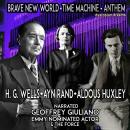
Brave New World Time Machine Anthem: A Dystopian Trilogy
"Aldous Huxley’s Brave New World portrays a dystopian future where societal stability is maintained through genetic engineering, conditioning, and a rigid caste system. Individual freedoms are sacrificed for collective happiness, with people pacified by the drug soma and distracted by hedonistic pleasures. The story follows Bernard Marx, Lenina Crowne, and John the Savage as they navigate a world devoid of deep emotional connections, grappling with the costs of a society that prioritizes comfort and order over humanity’s complexities. H.G. Wells’ The Time Machine follows an unnamed Time Traveller who invents a machine capable of traversing the fourth dimension. Venturing to the distant future, he encounters the Eloi, a gentle but passive race, and the Morlocks, sinister subterranean creatures. As he explores this fragmented society, he uncovers the grim consequences of humanity’s evolution and social division. The story is both an adventure and a profound commentary on the fragility of civilization and the inexorable march of time. Ayn Rand's Anthem presents a dystopian future where individuality is erased, and the word 'I' is forbidden. The protagonist, Equality 7-2521, defies this collectivist society by pursuing forbidden knowledge and discovering the power of self-expression. His journey leads him to reclaim his identity and embrace the idea of individual freedom as the highest value, rejecting the oppressive doctrines that suppress human potential and creativity."
Aldous Huxley, Ayn Rand, H.G. Wells (Author), Geoffrey Giuliano, The Force (Narrator)
Audiobook
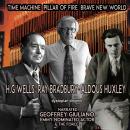
Time Machine Pillar Of Fire Brave New World
"H.G. Wells’s The Time Machine explores humanity's distant future through the eyes of a time traveler who witnesses the division of society into the fragile, passive Eloi and the brutish, subterranean Morlocks. It serves as a haunting critique of class disparities and the consequences of industrialization, painting a vision of evolution where technological and societal progress ultimately give way to decay and entropy. Ray Bradbury’s Pillar of Fire tells the story of a man resurrected in a dystopian future where books have been burned, emotions suppressed, and death sanitized. Through his defiance and yearning for the dark passions of the past, Bradbury crafts a tale of resistance against the erasure of individuality and the sterilization of humanity’s depth and complexity. Aldous Huxley’s Brave New World presents a chillingly efficient society where technology and psychological manipulation create an illusion of utopia. With individuality suppressed and genuine emotions replaced by artificial pleasures, the novel warns against sacrificing freedom and authenticity for comfort and stability, revealing the cost of a perfectly engineered existence."
Aldous Huxley, H.G. Wells, Ray Bradbury (Author), Geoffrey Giuliano, The Force (Narrator)
Audiobook
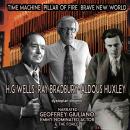
Time Machine Pillar Of Fire Brave New World
"H.G. Wells’s The Time Machine explores humanity's distant future through the eyes of a time traveler who witnesses the division of society into the fragile, passive Eloi and the brutish, subterranean Morlocks. It serves as a haunting critique of class disparities and the consequences of industrialization, painting a vision of evolution where technological and societal progress ultimately give way to decay and entropy. Ray Bradbury’s Pillar of Fire tells the story of a man resurrected in a dystopian future where books have been burned, emotions suppressed, and death sanitized. Through his defiance and yearning for the dark passions of the past, Bradbury crafts a tale of resistance against the erasure of individuality and the sterilization of humanity’s depth and complexity. Aldous Huxley’s Brave New World presents a chillingly efficient society where technology and psychological manipulation create an illusion of utopia. With individuality suppressed and genuine emotions replaced by artificial pleasures, the novel warns against sacrificing freedom and authenticity for comfort and stability, revealing the cost of a perfectly engineered existence."
Aldous Huxley, H.G. Wells, Ray Bradbury (Author), Geoffrey Giuliano, The Force (Narrator)
Audiobook
"George Orwell, a writer deeply concerned with social justice and the corrupting influence of power, authored two of the most iconic and influential works of the 20th century: 1984 and Animal Farm. Though distinct in their storytelling, both novels explore totalitarianism, manipulation, and the dangers of unchecked authority. In 1984, Orwell thrusts readers into a dystopian future where the omnipresent Party, led by the mysterious Big Brother, controls every facet of life. The protagonist, Winston Smith, battles against an oppressive regime that eradicates individuality, rewrites history, and criminalizes independent thought. Orwell’s portrayal of a society under constant surveillance, where even one's innermost thoughts can be punished, serves as a chilling cautionary tale about the abuse of power and the erosion of personal freedoms. Aldous Huxley’s Brave New World transports listeners to a futuristic society where technological advancements and genetic engineering have eliminated conflict, but at the cost of individuality, emotion, and freedom. In this seemingly utopian world, people are conditioned from birth to conform, pleasure is chemically induced, and dissent is eradicated. Through the eyes of the disillusioned outsider, Bernard Marx, and the 'savage' John, Huxley explores the dangers of losing humanity in the pursuit of stability and control."
Aldous Huxley, George Orwell (Author), Geoffrey Giuliano, The Force (Narrator)
Audiobook
A Letter From Aldous Huxley to George Orwell Regarding 1984
"In October of 1949, a few months after publication of George Orwell‘s masterpiece, Nineteen Eighty-Four, he received a letter from fellow author Aldous Huxley, a man who, 17 years previous, had seen his own nightmarish vision of society published in the form of the classic, Brave New World. What begins as a letter of praise soon becomes a brief comparison of the two novels, and an explanation as to why Huxley believes his own earlier work to be a more realistic prediction. It should be noted that in 1917, long before he wrote this letter, Aldous Huxley briefly taught Orwell French at Eton College in Berkshire."
Aldous Huxley (Author), Hugh V. Turner (Narrator)
Audiobook
©PTC International Ltd T/A LoveReading is registered in England. Company number: 10193437. VAT number: 270 4538 09. Registered address: 157 Shooters Hill, London, SE18 3HP.
Terms & Conditions | Privacy Policy | Disclaimer
Join our community for the latest bookish news, reading recommendations, exclusive opening extracts, author events and competitions. It\'s all free. And enter a monthly draw to win a £50 Gift Card. See past winners here
Join Our Community