

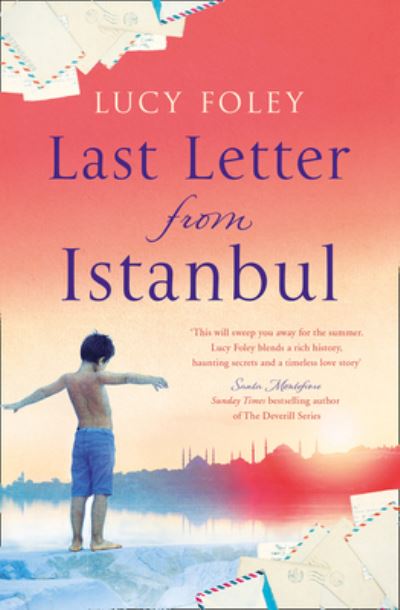
A beautiful soulful book with much realism and thought. It does start slowly with the character development in short chapters and I was a good way through before it became compelling, but when it does grab you it is a wonderful moment and I couldn't put it down.
This story is set in Istanbul in 1921 during the aftermath of WW1. It is about the impact of the war and the perceived occupation of the British and French on the local people who are trying to restore their lives and coming to terms with their loss of family, and of their way of life.
The characters are well developed through short chapters which give their point of view on events and how they are affected.
It is beautifully written with written illustrations of how the Turkish and British are working together whilst believing that each other to be in the wrong.
I thought it was well written. I will look out for more books by this author as I have never read any of her books before now.
Not what I would normally read but I gave it a go. Found it very difficult to get into and nearly gave up reading it, but as I was chosen by Love Reading to review it I thought I would keep going. Glad I didn’t give up, as by the end I enjoyed it. If I wasn’t reviewing it I think I would have given up after the first couple of chapters. One of the main reasons I nearly gave up is that the book is very slow to develop.
The book is based on life after World War One in Istanbul. Each of the chapters in the book are based on the individual characters of the book and are all written using 3rd person. Overall, I thought it was well written and if you do decide to read it don’t give up at the beginning as it does get better and pick up a little pace.
As the pace increased the book became a very good read. I loved this book and found it really thought provoking.
This is a slow burn. I found it difficult to get into at first as the chapters are all very short and seem very disjointed. However, as the pace increased the book became a very good read.
The story is about the mistrust between the English occupiers of Constantinople in 1921 and the local people. We are introduced to Nur who has to watch her former home being used as a military hospital. Her brother has gone to war and is presumed dead. She is caring for her mother and grandmother and teaching in the local school, taking her brother’s place. She is also caring for boy from the school, who has no home or family. When he becomes ill, Nur has no option but to apply to the hospital for medical care.
A tentative relationship develops between herself and the doctor caring for the boy although both are restricted by the awkwardness of the situation. The doctor saves the child and then Nur’s brother, who has returned from the war a broken and disillusioned man. The occupying force is eventually sent home and Nur has one last request to make of the doctor who has helped her.
The book ends with a visit many years later when an elderly Nur receives a visitor and the reader understands at last what her final request was, and the effect this has had on many lives.
Each chapter is succinctly but beautifully written and the overall feeling of the book is so evocative - colours, heat, smells are all vividly conveyed on every page. A really enjoyable, satisfying read.
Set in Allied occupied Istanbul, 1921, the story unfolds from four viewpoints. There is Nur, a young Turkish widow from a once wealthy, privileged family, George Munro, a British Army doctor in charge of a hospital for British servicemen and two characters described as the prisoner and the traveller.
Nur lives with her mother and grandmother and a little Armenian orphan for whom she has assumed responsibility. Their family home was confiscated during the war and has now become a hospital for British servicemen, run by Munro. Inevitably Nur and Munro's paths cross but the relationship that subsequently develops successfully avoids cliche and is the lynchpin around which the fates of the prisoner and the traveller revolve.
Lucy Foley attempts to transport you to another place and another time with Last Letter from Istanbul. I did enjoy this book as a light, easy to read novel
Written from several perspectives, this book covers the way different people are affected by war and the different, and often difficult, relationships that can prosper. However, it’s very much a romanticised story of war, and is very light reading.
Some of the characters, The Prisoner for example, lacked depth and felt on the periphery. It felt like the author was trying to be too clever and stick to a set format (each chapter from a different perspective) which wasn’t necessary and from my point of view was detrimental to the story. Especially so, where the chapters weren't from a person’s perspective but a time of year. It didn't work for me.
There is some great descriptive writing in places, you could certainly picture some of the scenes. But for me it felt a little shallow and I felt it was written from imagination rather than a reality.
The end of the book is very predictable, and whilst there’s supposed to be some mystery around who 'the Traveller' chapters are by, it’s too obvious and therefore, the ending feels a little lacklustre.
All that said, I did enjoy this book as a light, easy to read novel, it just left me wanting more in so many areas.
An enthralling, sumptuous, feast for the senses! One of those books where you're not quite sure where you are when you finally look up from the pages.
This engaging novel is set in Turkey, just after WWI. The Allied forces have occupied Istanbul and everyone has to learn to adjust to a new way of life. Nur is from a once wealthy family but with Turkey defeated in the War, everything she knows has changed beyond recognition. George is a doctor in the British Army, now based in Istanbul. Their worlds and lives collide.
Fantastic writing with evocative, griping imagery. Beautiful descriptions of places, sights, smells and tastes, all of which drew me in to the time and place. I don't know much about Turkey and the Ottoman Empire and this left me longing to know more. A truly engaging story which was a delight to read.
Quite simply the most beautifully, poignant book I have ever read! It is incredibly descriptive and engages all of your senses until you are totally immersed and transported to a time when Istanbul was an occupied city.
Quite simply the most beautifully, poignant book I have ever read!
It is incredibly descriptive and engages all of your senses until you are totally immersed and transported to a time when Istanbul was an occupied city.
The story is one of love, loss and sacrifice, it is heartbreakingly beautiful. It will stay imprinted in your mind long after you have turned the last page
The slow revealing nature of the book leaves the reader wondering and despite the short chapters, reading far too late into the night!
A window in to British involvement in Istanbul in the 1920's, and the impact on local people.
Istanbul is a city often in the news, but 100 years ago the British press would have referred to Constantinople and the Ottoman Empire. Last Letter from Istanbul reminds us that this fascinating and culturally diverse city is not new to conflict and throws a spotlight on the not entirely positive British involvement in this. This is not a story of noble savages however as wrong was done by all sides. The central characters in Lucy Foley's book are all flawed in some way, but each doing their best to cope with the situation they find themselves in. George and Nur we get to know by name early on, but the identities of The Prisoner and The Traveller are slowly and tantalisingly revealed.
The senses conjured up by the writing are beautiful, you can almost taste the ripe figs and smell the sea air.
At the heart of this gritty story set in occupied Constantinople is forbidden love at a time (1921) difficult to even contemplate today.
Nur takes on The Boy, an orphan as a result of the hostilities in the Ottaman Empire in the early 1920s. She is herself orphaned in the sense that the husband of her arranged marriage is missing presumed dead and she has had to abandon the family home which is lost to her other than the pain inspired by still being able to see it from her near slum like existence.
When The Boy falls ill, she takes the only step she can to ensure he survives and puts him in the hands of the enemy in the form of George. George is a British military doctor who symbolises everything that she has lost – his hospital is in fact he home she was forced to abandon and he represents those who took her loved ones and life as she knew it.
Interweaved between chapters focused on Nur, The Boy and George are those describing the lot of The Prisoner and The Traveller. How all these seeming disparate stories come together adds an additional dimension to an already very engaging story.
If you like a well written, meaty romance, then I can definitely recommend this one. And if you like a plot set at a time in history in the cusp of social change, then this is a must.
This book explores notions of belonging and identity that are rarely externalised to others, but nevertheless felt and experienced.
There are probably not too many fictionalised accounts of Turkey from this particular era, and I found the storyline both poignant and moving. Nur's experiences as a well-off daughter who has to come to terms with her brother going off as a soldier and taking over for him as the local teacher are well-drawn, although I never quite felt privy to her thoughts and feelings. The changing perspectives added a lot to this book, allowing Lucy Foley to explore notions of belonging and identity that are rarely externalised to others, but nevertheless felt and experienced. Nur, well-educated, brave, breadwinner, surrogate parent, does not quite "belong", any more than her young charge does. The British doctor George and Nur's brother don't "belong" either, one refusing to fit into the stereotype of the occupier, one eternally changed by the horrors of war. I will admit that it took me a while to get going with this book, but once I had the different narrators sorted in my head, this is a moving account of how people try to defy life's and society's expectations of them.
This is a breath-taking story. It is very good and the descriptions are really eloquent.
This is a breath-taking story. It is very gNur has been brought up as the cossetted daughter of a wealthy Turkish man. She is more accustomed to reaching for the next fig than struggling to survive as she must do following WW1. Instead of a return to normality the bungling allies carve the map and create years of future harm, in this case by occupying what they rename as Constantinople.
An unassuming, kind, Scottish doctor has volunteered to serve at the local military hospital. This is the basis for a love story and dance of keeping within decorous rules which are constantly changing. Nur had never worn a veil, but it is now considered a sign of respectability in a woman who encounters the occupying enemy – even when he does her less harm than her own family.
This is a breath-taking story which needs a lot of patience because of the silly fashion for breaking the continuity to keep it bite-sized, presumably for the perceived limited attention span of the reader. With four strands of narrative jumbled together one of which is over 40 years later than the others it is very frustrating. I just hope when the next fad comes along the book is reissued in a form more worthy of it. It is very good and the descriptions are really eloquent.od and the descriptions are really eloquent.
This is probably one of the best books I have read in the last year.
A story of war, love, loss and the consequences of our actions. A small cast of characters in the aftermath of WW1 when the victorious Allies occupy Istanbul, and the Turkish residents try to exist.
This is probably one of the best books I have read in the last year. Set mainly in 1921 with some chapters taking place during WW1 and some 'almost a lifetime later', the book tells a sweet, sad and sometimes horrific story of war, love and loss. There are only a few main characters, Nur a Turkish woman living in straitened circumstances; the boy, one of her pupils; the prisoner, her brother; George, the military doctor; and the traveller, travelling in the 60s. The story, written in short chapters by each individual, takes place in a bustling city occupied by the victorious Allies. The boy becomes very ill and Nur takes him to George in his hospital situated in Nur's former home. Gradually a relationship grows between Nur and George despite problems encountered by the tensions of occupation. The story unfolds slowly with beautiful descriptive passages of nature, the city and food. The horrors of war are not ignored, and there is reference to the Armenian massacres. Hope is not lost though. And although the story is heartbreakingly sad, it reaches a satisfying conclusion.
A delightful book you simply can’t put down.
A feast of memories, secrets and war in occupied Constantinople
It’s a need for survival that brings one man, one woman & an orphaned boy together.
Fabulous read.
The chapters take you on a journey back in time to an Istanbul once full of promise.
Where the streets were full of the sights & sounds of energy, where the smells of freshly baked breads and sweets filled your nostrils and the city was a truly wonderful place to be.
But like most things, nothing wonderful lasts forever and this is true for Nur.
Like all wars they change lives forever & this one is no different.
It’s about what was & what is now...secrets, trust and loss.
One woman, One Man and an Orphaned Boy all brought together out of necessity.
A book that filled my heart with love and hope and made me realise how frail yet strong the human race is. An emotional rollercoaster of a book with hidden depths. Magnificent.
1921 in occupied Constantinople. The Allied Forces stayed for three years. Nur lives in poverty above the dockyards whilst her palatial family home is now a British army hospital. A young widow with a brother, Kerem reported missing in the war, Nur teaches young children and has an orphan in her care, an Armenian boy.
The horror and injustice of the war affects her greatly and she is reduced to selling linen to support her mother, grandmother and the boy. When the boy becomes seriously ill, she is torn between her love for him and the hatred of the British at the hospital in her former home.
Nur agonises over love, culture and family loyalty, whilst Kerem’s helplessness turns to anger towards the occupiers, unable to deal with his actions. The boy’s innocence and forgiveness is breathtaking and is an unwitting pawn between Nur and George, the British doctor.
The author’s descriptions of how ordinary people thrown into a war and living with the consequences are exceptionally philosophical and compassionate. The characters deftly show sensitivity, bravery, deception, risks, secrets, betrayal and courage. A book that filled my heart with love and hope and made me realise how frail yet strong the human race is. An emotional rollercoaster of a book interspersed with prescience. The vivid descriptions are breath-taking and I defy anyone not to want to visit Istanbul after reading this. The writing is insightful and smart, keeping the reader guessing right until the very end of the book.
If you like a well written, meaty romance, then I can definitely recommend this one. And if you like a plot set at a time in history in the cusp of social change, then this is a must.
At the heart of this gritty story set in occupied Constantinople, is forbidden love at a time (1921) difficult to even contemplate today. Nur takes on The Boy, an orphan as a result of the hostilities in the Ottaman Empire in the early 1920s. She is herself orphaned in the sense that the husband of her arranged marriage is missing, presumed dead and she has had to abandon the family home which is lost to her other than the pain inspired by still being able to see it from her near slum like existence. When The Boy falls ill, she takes the only step she can to ensure he survives and puts him in the hands of the enemy in the form of George. George is a British military doctor who symbolises everything that she has lost – his hospital is in fact her home she was forced to abandon and he represents those who took her loved ones and life as she knew it. Interweaved between chapters focused on Nur, The Boy and George are those describing the lot of The Prisoner and The Traveller. How all these seemingly desperate stories come together adds an additional dimension to an already very engaging story. If you like a well written, meaty romance, then I can definitely recommend this one. And if you like a plot set at a time in history in the cusp of social change, then this is a must.
I really enjoyed this story and I would recommend this to anyone with an interest in wartime stories.
The story is set in 1921 and is told from different people’s perspectives , but it centers around one woman called Nur . Nur’s home has now been turned into a hospital for wounded soldiers belonging to the enemy much to her horror. Nur is a teacher and she has taken under her wing a curious young boy that needs looking after . When he gets seriously ill she has to turn to the last person she ever imagined she would ask for help ... The Enemy. The story is bittersweet, the heartbreak and confusion of emotions during wartime is really well described and the turmoil that war brings to families is enough to bring a tear to your eye.