

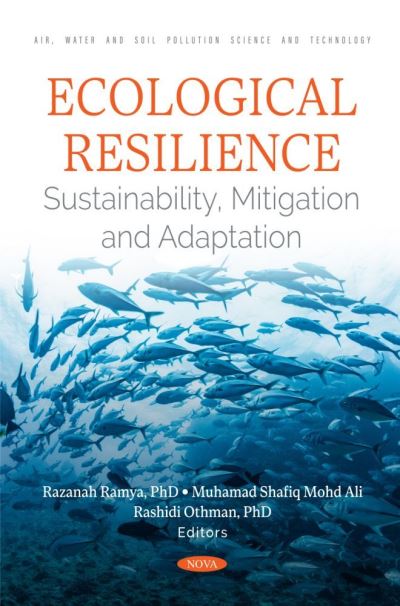
This book presents a current study of the vital value of ecology, perspective and strategies for sustainability in the future. The term resilience in this book has been chosen to reflect the robust interchangeability of environmental systems to continuously function and recover from a disturbance. Therefore, the book entitled "Ecological Resilience: Sustainability, Mitigation and Adaptation" has been chosen to discuss the recent study regarding sustainability, mitigation and adaptation towards ecology.
There are eight chapters contained in this book. Chapter 1 describes the perspectives, strategies and applications in the current scenario whereas Chapter 2 elaborates on research conducted to quantify surface water quality within the three years of the COVID-19 endemic at one of the famous recreational beaches in Port Dickson, Malaysia. Chapter 3 analyzes the handline catches and the proportional length of maturity from North Maluku, Indonesia.
Chapter 4 determines the concentration and distribution of nitrates, phosphates, organic matter, and phytoplankton abundance while evaluating the level of pollution in the coastal waters of Rupat Island, Indonesia. Chapter 5 explores the various plant-based pigments that the Malay community uses as natural dye colorants such as Bixa orellana (Annatto), Lawsonia enermis (henna), Garcinia mangostana (mangosteen), Areca catechu (betel nut), Hylocereus polyhizus (red pitaya), Morinda citrifolia (mengkudu), Clitoria ternatea (butterfly pea flower), and Caesalpinia sappan (sappan wood).
Meanwhile, Chapter 6 explores the allelopathic properties of certain plants (Melaleuca cajuputi) from heath forest ecosystems as potential agents for sustainable landscape maintenance. Next, Chapter 7 discusses sustainable tourism: navigating ecosystems, communities, and technological frontiers for a harmonious future. Last but not least, Chapter 8 describes applied technology to absorb CO?, produce O? and culture biomass Chlorella using a Dahril bottle.
May this book deliver great benefits to the readers, especially for students, academicians, researchers and agencies.
| ISBN: | 9798891139923 |
| Publication date: | 30th August 2024 |
| Author: | Razanah Ramya, Rashidi Othman, Muhamad Shafiq Mohd Ali |
| Publisher: | Nova Science Publishers an imprint of Nova Science Publishers, Inc. |
| Format: | Paperback |
| Pagination: | 141 pages |
| Series: | Environmental Science, Engineering and Technology |
| Genres: |
The Earth: natural history: general interest Physical geography and topography |
This book presents a current study of the vital value of ecology, perspective and strategies for sustainability in the future. The term resilience in this book has been chosen to reflect the robust interchangeability of environmental systems to continuously function and recover from a disturbance.
Ecological Resilience features in the following genres: The Earth: natural history: general interest, Physical geography and topography
Paperback. £76.49, down from the £84.99 cover price. Not Available.
Ecological Resilience was written by Razanah Ramya, Rashidi Othman, Muhamad Shafiq Mohd Ali and published by Nova Science Publishers an imprint of Nova Science Publishers, Inc.
Ecological Resilience has 141 pages
Yes it is part of Environmental Science, Engineering and Technology series
£76.49, reduced from £84.99. Not Available.