

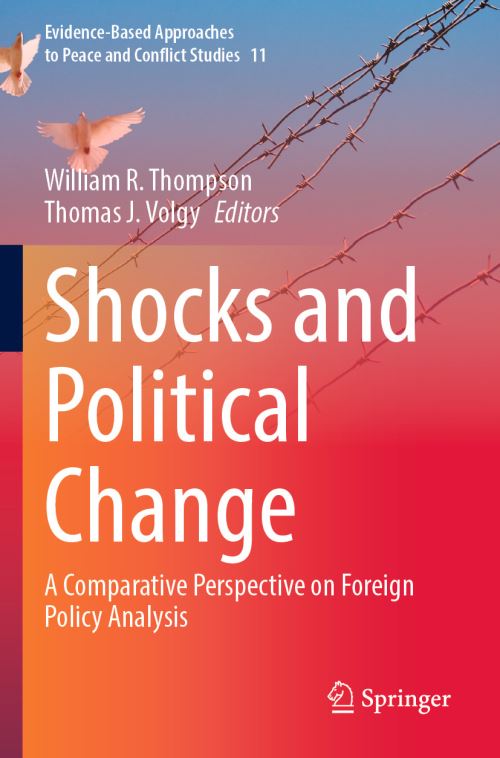
Political shocks have come to be considered highly salient for explaining major changes to international politics and to the foreign policies of states. Such shocks can occur at all levels of analysis: domestically, dyadically, regionally, or globally. They range from political phenomena such as coups and wars to ecological catastrophes. These shocks are sufficiently disruptive to cause foreign policy makers to reconsider their foreign policy orientations and to contemplate major changes to their policies. In fact, some have argued that it is mostly through political shocks that fundamental policy change occurs in most states. No wonder then that political shocks are now increasingly part of the toolbox of considerations used by foreign policy and international relations scholars as they focus on understanding patterns of conflict and cooperation between states.
Given the salience of political shocks to understand foreign policy change, this book brings together a group of both senior and more junior scholars whose previous work has shown substantial promise for moving forward theory and empirical analysis. Their combined efforts in this book highlight the value of multiple theoretical and empirical approaches to a clearer understanding of the nature of political shocks and their consequences for foreign policy and international politics.
| ISBN: | 9789819915002 |
| Publication date: | 4th June 2024 |
| Author: | William R Thompson, Thomas J Volgy |
| Publisher: | Springer an imprint of Springer Nature Singapore |
| Format: | Paperback |
| Pagination: | 256 pages |
| Series: | Evidence-Based Approaches to Peace and Conflict Studies |
| Genres: |
International relations |
Political shocks have come to be considered highly salient for explaining major changes to international politics and to the foreign policies of states. Such shocks can occur at all levels of analysis: domestically, dyadically, regionally, or globally.
Shocks and Political Change features in the following genres: International relations
Paperback. £107.99, down from the £119.99 cover price. Not Available.
Shocks and Political Change was written by William R Thompson, Thomas J Volgy and published by Springer an imprint of Springer Nature Singapore
Shocks and Political Change has 256 pages
Yes it is part of Evidence-Based Approaches to Peace and Conflict Studies series
£107.99, reduced from £119.99. Not Available.