

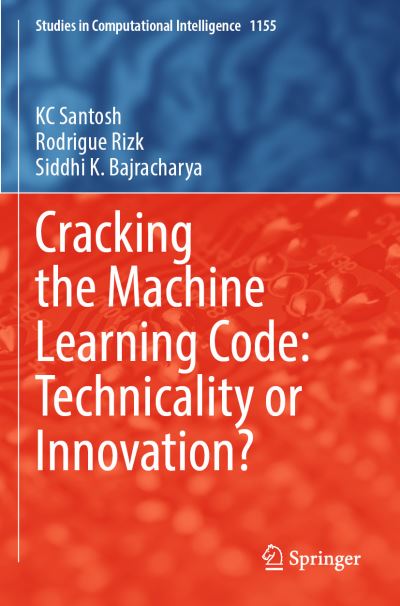
Employing off-the-shelf machine learning models is not an innovation. The journey through technicalities and innovation in the machine learning field is ongoing, and we hope this book serves as a compass, guiding the readers through the evolving landscape of artificial intelligence. It typically includes model selection, parameter tuning and optimization, use of pre-trained models and transfer learning, right use of limited data, model interpretability and explainability, feature engineering and autoML robustness and security, and computational cost - efficiency and scalability. Innovation in building machine learning models involves a continuous cycle of exploration, experimentation, and improvement, with a focus on pushing the boundaries of what is achievable while considering ethical implications and real-world applicability. The book is aimed at providing a clear guidance that one should not be limited to building pre-trained models to solve problems using the off-the-self basic building blocks. With primarily three different data types: numerical, textual, and image data, we offer practical applications such as predictive analysis for finance and housing, text mining from media/news, and abnormality screening for medical imaging informatics. To facilitate comprehension and reproducibility, authors offer GitHub source code encompassing fundamental components and advanced machine learning tools.
| ISBN: | 9789819727223 |
| Publication date: | 10th May 2025 |
| Author: | K C Santosh, Rodrigue Rizk, Siddhi K Bajracharya |
| Publisher: | Springer an imprint of Springer Nature Singapore |
| Format: | Paperback |
| Pagination: | 127 pages |
| Series: | Studies in Computational Intelligence |
| Genres: |
Artificial intelligence Machine learning Databases |
Employing off-the-shelf machine learning models is not an innovation. The journey through technicalities and innovation in the machine learning field is ongoing, and we hope this book serves as a compass, guiding the readers through the evolving landscape of artificial intelligence.
Cracking the Machine Learning Code features in the following genres: Artificial intelligence, Machine learning, Databases
Paperback, Hardback. £125.99, down from the £139.99 cover price. Not Available.
Cracking the Machine Learning Code was written by K C Santosh, Rodrigue Rizk, Siddhi K Bajracharya and published by Springer an imprint of Springer Nature Singapore
Cracking the Machine Learning Code has 127 pages
Yes it is part of Studies in Computational Intelligence series
£125.99, reduced from £139.99. Not Available.