

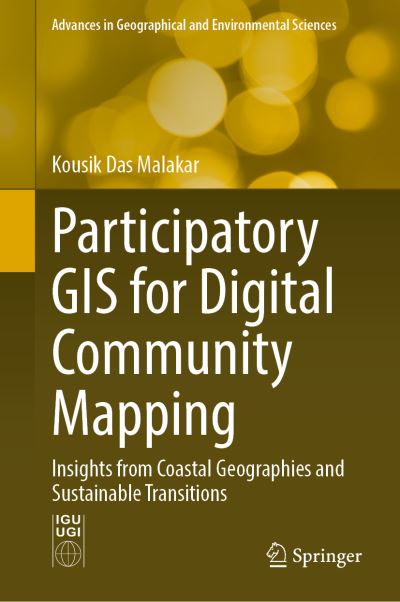
This book presents an innovative, interdisciplinary exploration of how participatory geospatial methods are transforming contemporary understandings of environmental governance, sustainability, and community resilience. Based on the idea that mapping is not merely a technical exercise but also a social, political, and cultural practice, the volume situates participatory GIS within the lived experiences of coastal communities, presenting a transformative framework for inclusive spatial knowledge production.
Organized in three parts, the book begins by discussing the theoretical foundations of participatory GIS in the context of coastal geographies and digital community mapping, emphasizing its potential to transform governance and sustainability discourses. The second part offers field-based applications from coastal India, featuring participatory data collection, lived narratives, mapping workshops, and case studies that illustrate community-centred approaches to environmental management and policy transitions. The last part presents a research and philosophical agenda for participatory GIS, positioning it as a driver for sustainable futures, ethical innovation, and transdisciplinary collaboration.
The book's uniqueness lies in its threefold integrated approach, combining theoretical perspectives, empirical practices, and forward-looking insights to connect spatial technology, social engagement, and sustainability science. It blends academic rigor with practical relevance, providing valuable guidance for policymakers, planners, and institutions interested in participatory frameworks for environmental decision-making and coastal sustainability. For scholars and students in geography, environmental studies, and geoinformatics, it serves as both a conceptual reference and a methodological guide to participatory mapping in the digital era. Finally, this monograph introduces a fresh narrative in geographical scholarship, envisioning participatory GIS as a transformative tool for promoting spatial justice, community empowerment, and sustainable environmental futures.
| ISBN: | 9789819251018 |
| Publication date: | 22nd October 2026 |
| Author: | Kousik Das Malakar |
| Publisher: | Springer an imprint of Springer Nature Singapore |
| Format: | Hardback |
| Pagination: | 548 pages |
| Series: | Advances in Geographical and Environmental Sciences |
| Genres: |
Sustainability Human geography Geographical information systems, geodata and remote sensing |
This book presents an innovative, interdisciplinary exploration of how participatory geospatial methods are transforming contemporary understandings of environmental governance, sustainability, and community resilience. Based on the idea that mapping is not merely a technical exercise but also a social, political, and cultural practice, the volume situates participatory GIS within the lived experiences of coastal communities, presenting a transformative framework for inclusive spatial knowledge production.Organized in three parts, the book begins by discussing the theoretical foundations of participatory GIS in the context of coastal geographies and digital community mapping, emphasizing its potential to transform governance and sustainability discourses.
Participatory GIS for Digital Community Mapping features in the following genres: Sustainability, Human geography, Geographical information systems, geodata and remote sensing
Hardback. £134.99, down from the £149.99 cover price. Not Available.
Participatory GIS for Digital Community Mapping was written by Kousik Das Malakar and published by Springer an imprint of Springer Nature Singapore
Participatory GIS for Digital Community Mapping has 548 pages
Yes it is part of Advances in Geographical and Environmental Sciences series
£134.99, reduced from £149.99. Not Available.