

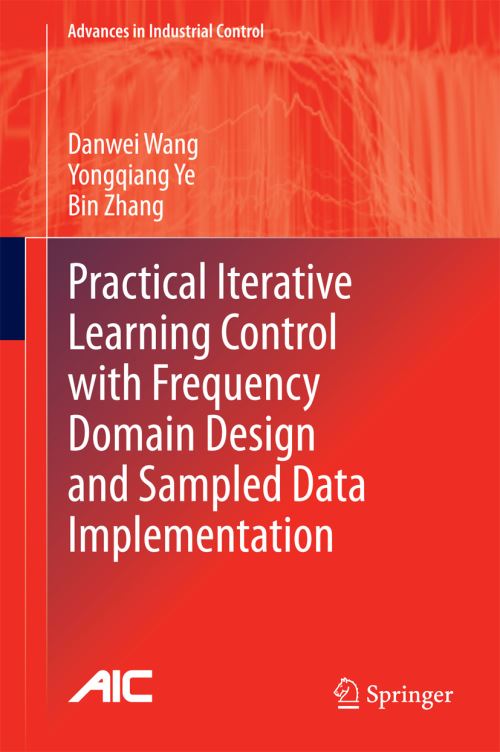
This book is on the iterative learning control (ILC) with focus on the design and implementation. We approach the ILC design based on the frequency domain analysis and address the ILC implementation based on the sampled data methods. This is the first book of ILC from frequency domain and sampled data methodologies.
The frequency domain design methods offer ILC users insights to the convergence performance which is of practical benefits. This book presents a comprehensive framework with various methodologies to ensure the learnable bandwidth in the ILC system to be set with a balance between learning performance and learning stability. The sampled data implementation ensures effective execution of ILC in practical dynamic systems.
The presented sampled data ILC methods also ensure the balance of performance and stability of learning process. Furthermore, the presented theories and methodologies are tested with an ILC controlled robotic system. The experimental results show that the machines can work in much higher accuracy than a feedback control alone can offer.
With the proposed ILC algorithms, it is possible that machines can work to their hardware design limits set by sensors and actuators. The target audience for this book includes scientists, engineers and practitioners involved in any systems with repetitive operations.
| ISBN: | 9789814585590 |
| Publication date: | 8th July 2014 |
| Author: | Danwei Wang, Yongqiang Ye |
| Publisher: | Springer an imprint of Springer Nature Singapore |
| Format: | Hardback |
| Pagination: | 235 pages |
| Series: | Advances in Industrial Control |
| Genres: |
Artificial intelligence Mathematical modelling Optical physics |
This book is on the iterative learning control (ILC) with focus on the design and implementation. We approach the ILC design based on the frequency domain analysis and address the ILC implementation based on the sampled data methods.
Iterative Learning Control Design and Implementation features in the following genres: Artificial intelligence, Mathematical modelling, Optical physics
Hardback. Not Available.
Iterative Learning Control Design and Implementation was written by Danwei Wang, Yongqiang Ye and published by Springer an imprint of Springer Nature Singapore
Iterative Learning Control Design and Implementation has 235 pages
Yes it is part of Advances in Industrial Control series