

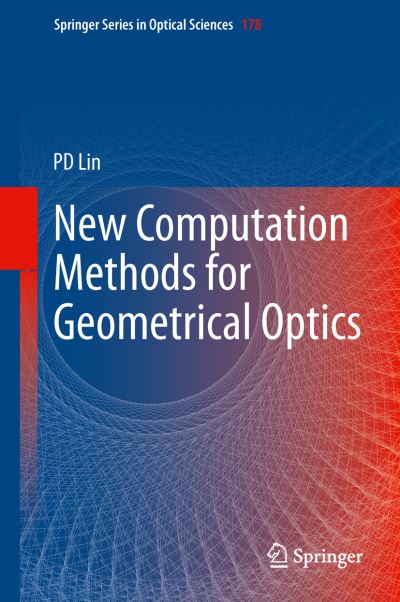
This book employs homogeneous coordinate notation to compute the first- and second-order derivative matrices of various optical quantities. It will be one of the important mathematical tools for automatic optical design. The traditional geometrical optics is based on raytracing only.
It is very difficult, if possible, to compute the first- and second-order derivatives of a ray and optical path length with respect to system variables, since they are recursive functions. Consequently, current commercial software packages use a finite difference approximation methodology to estimate these derivatives for use in optical design and analysis. Furthermore, previous publications of geometrical optics use vector notation, which is comparatively awkward for computations for non-axially symmetrical systems.
| ISBN: | 9789814451789 |
| Publication date: | 15th October 2013 |
| Author: | P D Lin |
| Publisher: | Springer an imprint of Springer Nature Singapore |
| Format: | Hardback |
| Pagination: | 239 pages |
| Series: | Springer Series in Optical Sciences |
| Genres: |
Electricity, electromagnetism and magnetism Laser physics Optical physics Quantum physics (quantum mechanics and quantum field theory) Mathematical physics Electronics engineering |
This book employs homogeneous coordinate notation to compute the first- and second-order derivative matrices of various optical quantities. It will be one of the important mathematical tools for automatic optical design.
New Computation Methods for Geometrical Optics features in the following genres: Electricity, electromagnetism and magnetism, Laser physics, Optical physics, Quantum physics (quantum mechanics and quantum field theory), Mathematical physics, Electronics engineering
Hardback. Not Available.
New Computation Methods for Geometrical Optics was written by P D Lin and published by Springer an imprint of Springer Nature Singapore
New Computation Methods for Geometrical Optics has 239 pages
Yes it is part of Springer Series in Optical Sciences series