

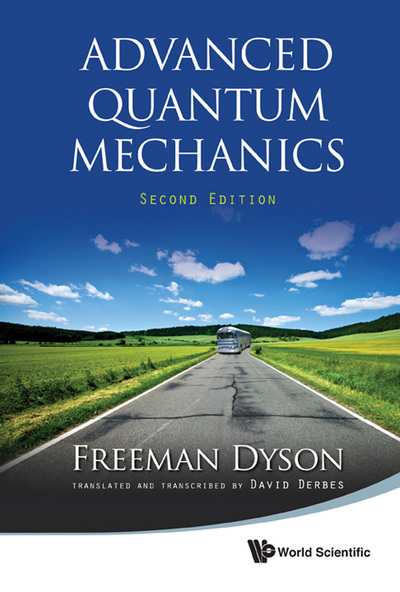
Renowned physicist and mathematician Freeman Dyson is famous for his work in quantum mechanics, nuclear weapons policy and bold visions for the future of humanity. In the 1940s, he was responsible for demonstrating the equivalence of the two formulations of quantum electrodynamics - Richard Feynman's diagrammatic path integral formulation and the variational methods developed by Julian Schwinger and Sin-Itiro Tomonoga - showing the mathematical consistency of QED.This invaluable volume comprises the legendary lectures on quantum electrodynamics first given by Dyson at Cornell University in 1951.
The late theorist Edwin Thompson Jaynes once remarked, "For a generation of physicists they were the happy medium: clearer and better motivated than Feynman, and getting to the point faster than Schwinger".This edition has been printed on the 60th anniversary of the Cornell lectures, and includes a foreword by science historian David Kaiser, as well as notes from Dyson's lectures at the Les Houches Summer School of Theoretical Physics in 1954.
The Les Houches lectures, described as a supplement to the original Cornell notes, provide a more detailed look at field theory, a careful and rigorous derivation of Fermi's Golden Rule, and a masterful treatment of renormalization and Ward's Identity.Future generations of physicists are bound to read these lectures with pleasure, benefiting from the lucid style that is so characteristic of Dyson's exposition.
| ISBN: | 9789814383417 |
| Publication date: | 8th December 2011 |
| Author: | Freeman J Dyson |
| Publisher: | World Scientific Publishing an imprint of WORLD SCIENTIFIC |
| Format: | Paperback |
| Pagination: | 316 pages |
| Genres: |
Quantum physics (quantum mechanics and quantum field theory) |
Renowned physicist and mathematician Freeman Dyson is famous for his work in quantum mechanics, nuclear weapons policy and bold visions for the future of humanity. In the 1940s, he was responsible for demonstrating the equivalence of the two formulations of quantum electrodynamics - Richard Feynman's diagrammatic path integral formulation and the variational methods developed by Julian Schwinger and Sin-Itiro Tomonoga - showing the mathematical consistency of QED.This invaluable volume comprises the legendary lectures on quantum electrodynamics first given by Dyson at Cornell University in 1951.
Advanced Quantum Mechanics features in the following genres: Quantum physics (quantum mechanics and quantum field theory)
Paperback. £31.50, down from the £35.00 cover price. Not Available.
Advanced Quantum Mechanics was written by Freeman J Dyson and published by World Scientific Publishing an imprint of WORLD SCIENTIFIC
Advanced Quantum Mechanics has 316 pages
£31.50, reduced from £35.00. Not Available.