

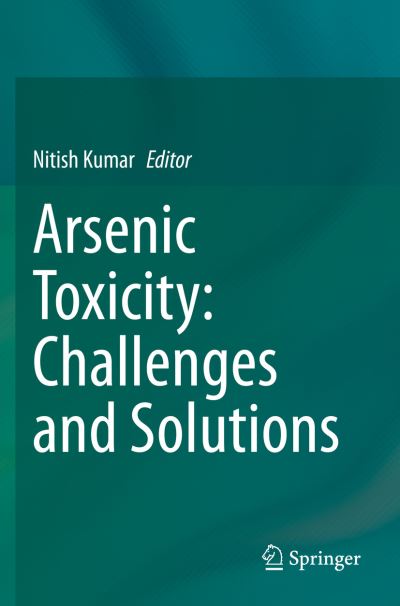
Arsenic (As) is a widely distributed element in the environment having no known useful physiological function in plants or animals. Historically, this metalloid has been known to be used widely as a poison. Effects of arsenic have come to light in the past few decades due to its increasing contamination in several parts of world, with the worst situation being in Bangladesh and West Bengal in India. This edited volume brings together diverse group of environmental science, sustainability and health researchers to address the challenges posed by global mass poisoning caused by arsenic water contamination.
The book covers sources of arsenic contamination, and its impact on human health and on prospective remediation both by bioremediation and phytoremediation. Applications of advance techniques such as genetic engineering and nanotechnology are also discussed to resolve the issue of arsenic contamination in ground water and river basins. The book sheds light on thisglobal environmental issue, and proposes solutions to remove contamination through a multi-disciplinary lens and case studies from Bangladesh and India.
The book may serve as a reference to environment and sustainability researchers, students and policy makers. It delivers an outline to graduate, undergraduate students and researchers, as well as academicians who are working on arsenic toxicity with respect to remediation and health issues.
| ISBN: | 9789813360709 |
| Publication date: | 17th February 2022 |
| Author: | Nitish Kumar |
| Publisher: | Springer an imprint of Springer Nature Singapore |
| Format: | Paperback |
| Pagination: | 413 pages |
| Genres: |
Plant biology Agricultural science Biochemistry Botany and plant sciences |
Arsenic (As) is a widely distributed element in the environment having no known useful physiological function in plants or animals. Historically, this metalloid has been known to be used widely as a poison.
Arsenic Toxicity features in the following genres: Plant biology, Agricultural science, Biochemistry, Botany and plant sciences
Paperback, Hardback. £179.99, down from the £199.99 cover price. Not Available.
Arsenic Toxicity was written by Nitish Kumar and published by Springer an imprint of Springer Nature Singapore
Arsenic Toxicity has 413 pages
£179.99, reduced from £199.99. Not Available.