

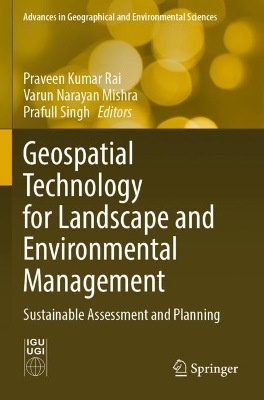
Geospatial technology is a combination of state-of-the-art remote sensing and technology for geographic information systems (GIS) and global navigation satellite systems (GNSS) for the mapping and monitoring of landscapes and environment. The main thrust of using geospatial technology is to understand the causes, mechanisms, and consequences of spatial heterogeneity, while its ultimate objective is to provide a scientific basis for developing and maintaining ecologically, economically, and socially sustainable landscapes.
This book presents new research on the interdisciplinary applications of geospatial technology for identification, assessment, monitoring, and modelling issues related to landscape, natural resources, and environmental management. The book specifically focuses on the creation, collection, storage, processing, modelling, interpretation, display, and dissemination of spatio-temporal data, which help to resolve environmental management issues including ecosystem change,resource utilization, land use management, and environmental pollution.
The positive environmental impacts of information technology advancements with regard to global environmental and climate change are also discussed. The book addresses the interests of a wide spectrum of readers who have a common interest in geospatial science, geology, water resource management, database management, planning and policy making, and resource management.
| ISBN: | 9789811673757 |
| Publication date: | 12th January 2023 |
| Author: | Praveen Kumar Rai |
| Publisher: | Springer Verlag, Singapore |
| Format: | Paperback |
| Pagination: | 430 pages |
| Series: | Advances in Geographical and Environmental Sciences |
| Genres: |
Geographical information systems, geodata and remote sensing Environmental management Meteorology and climatology Natural disasters Databases |
Geospatial technology is a combination of state-of-the-art remote sensing and technology for geographic information systems (GIS) and global navigation satellite systems (GNSS) for the mapping and monitoring of landscapes and environment. The main thrust of using geospatial technology is to understand the causes, mechanisms, and consequences of spatial heterogeneity, while its ultimate objective is to provide a scientific basis for developing and maintaining ecologically, economically, and socially sustainable landscapes.
Geospatial Technology for Landscape and Environmental Management features in the following genres: Geographical information systems, geodata and remote sensing, Environmental management, Meteorology and climatology, Natural disasters, Databases
Paperback. £134.99, down from the £149.99 cover price. Not Available.
Geospatial Technology for Landscape and Environmental Management was written by Praveen Kumar Rai and published by Springer Verlag, Singapore
Geospatial Technology for Landscape and Environmental Management has 430 pages
Yes it is part of Advances in Geographical and Environmental Sciences series
£134.99, reduced from £149.99. Not Available.