

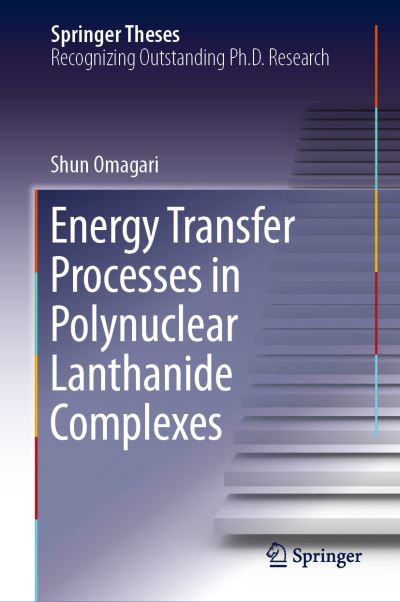
This book describes the luminescence mechanism of polynuclear lanthanide complexes, focusing on energy transfer processes using a combination of experimental and theoretical approaches.
Lanthanide complexes show intense luminescence from the lanthanide ion through sensitization by the organic ligands. The high chromaticity of the emission and the long lifetimes of the complexes are particularly attractive for applications such as organic light-emitting diodes and bioprobes. Polynuclear lanthanide complexes (coordination polymers and clusters) have attracted considerable interest for functionalization by energy transfer between lanthanide ions.
At the same time, such extra processes complicate the luminescence mechanism, hindering the rational design of functional polynuclear lanthanide complexes.
Firstly, the book explains the principle of the theoretical methods, and then describes the concentration-quenching mechanism in coordination polymers. It also examines theeffect of intrinsic spin-orbit coupling arising from lanthanide ions on the ligand-to-lanthanide energy transfer efficiency and the mechanism of back energy transfer (the opposite of sensitizing energy transfer) in lanthanide clusters. This sets the stage for the final topic: the suppression of back energy transfer by energy transfer between lanthanide ions in lanthanide clusters, which is of critical importance, showing that the lanthanide clusters can be considered a new generation of functional and efficient luminescent material and could also provide a breakthrough in lanthanide photophysics.
| ISBN: | 9789811360480 |
| Publication date: | 28th January 2019 |
| Author: | Shun Omagari |
| Publisher: | Springer an imprint of Springer Nature Singapore |
| Format: | Hardback |
| Pagination: | 140 pages |
| Series: | Springer Theses |
| Genres: |
Organometallic chemistry Quantum and theoretical chemistry Engineering applications of polymers and composites Physical chemistry Inorganic chemistry |
This book describes the luminescence mechanism of polynuclear lanthanide complexes, focusing on energy transfer processes using a combination of experimental and theoretical approaches. Lanthanide complexes show intense luminescence from the lanthanide ion through sensitization by the organic ligands.
Energy Transfer Processes in Polynuclear Lanthanide Complexes features in the following genres: Organometallic chemistry, Quantum and theoretical chemistry, Engineering applications of polymers and composites, Physical chemistry, Inorganic chemistry
Hardback. Not Available.
Energy Transfer Processes in Polynuclear Lanthanide Complexes was written by Shun Omagari and published by Springer an imprint of Springer Nature Singapore
Energy Transfer Processes in Polynuclear Lanthanide Complexes has 140 pages
Yes it is part of Springer Theses series