
10% off all books and free delivery over £50
Buy from our bookstore and 25% of the cover price will be given to a school of your choice to buy more books. *15% of eBooks.

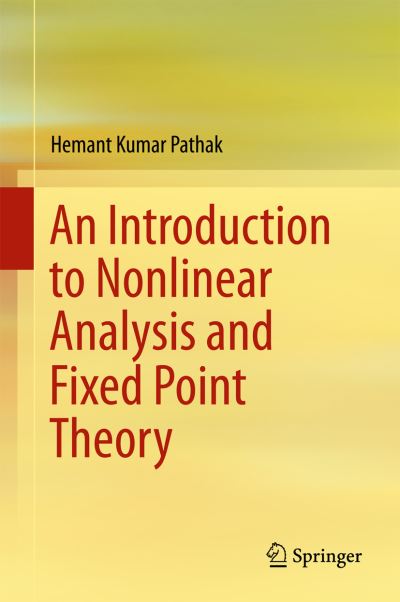
An Introduction to Nonlinear Analysis and Fixed Point Theory

View All Editions (2)

The selected edition of this book is not available to buy right now.
Add To Wishlist
Write A Review

About

An Introduction to Nonlinear Analysis and Fixed Point Theory Synopsis

This book systematically introduces the theory of nonlinear analysis, providing an overview of topics such as geometry of Banach spaces, differential calculus in Banach spaces, monotone operators, and fixed point theorems. It also discusses degree theory, nonlinear matrix equations, control theory, differential and integral equations, and inclusions. The book presents surjectivity theorems, variational inequalities, stochastic game theory and mathematical biology, along with a large number of applications of these theories in various other disciplines. Nonlinear analysis is characterised by its applications in numerous interdisciplinary fields, ranging from engineering to space science, hydromechanics to astrophysics, chemistry to biology, theoretical mechanics to biomechanics and economics to stochastic game theory.
 
Organised into ten chapters, the book shows the elegance of the subject and its deep-rooted concepts and techniques, which provide the tools for developing more realistic and accurate models for a variety of phenomena encountered in diverse applied fields. It is intended for graduate and undergraduate students of mathematics and engineering who are familiar with discrete mathematical structures, differential and integral equations, operator theory, measure theory, Banach and Hilbert spaces, locally convex topological vector spaces, and linear functional analysis.

About This Edition

ISBN: 9789811088650
Publication date:
Author: Hemant Kumar Pathak
Publisher: Springer an imprint of Springer Nature Singapore
Format: Hardback
Pagination: 830 pages
Genres: Calculus and mathematical analysis

Frequently asked questions