

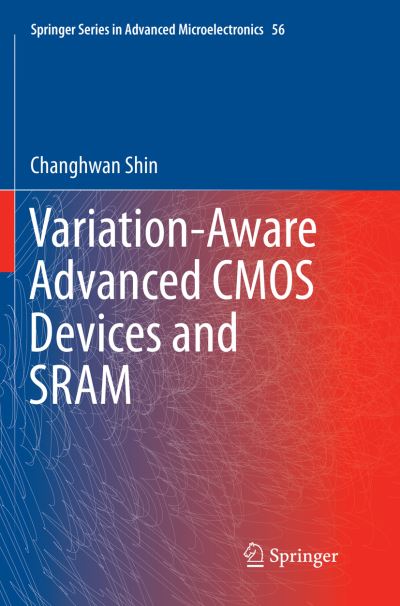
This book provides a comprehensive overview of contemporary issues in complementary metal-oxide semiconductor (CMOS) device design, describing how to overcome process-induced random variations such as line-edge-roughness, random-dopant-fluctuation, and work-function variation, and the applications of novel CMOS devices to cache memory (or Static Random Access Memory, SRAM). The author places emphasis on the physical understanding of process-induced random variation as well as the introduction of novel CMOS device structures and their application to SRAM.
The book outlines the technical predicament facing state-of-the-art CMOS technology development, due to the effect of ever-increasing process-induced random/intrinsic variation in transistor performance at the sub-30-nm technology nodes. Therefore, the physical understanding of process-induced random/intrinsic variations and the technical solutions to address these issues plays a key role in new CMOS technology development.This book aims to provide the reader with a deep understanding of the major random variation sources, and the characterization of each random variation source. Furthermore, the book presents various CMOS device designs to surmount the random variation in future CMOS technology, emphasizing the applications to SRAM.
| ISBN: | 9789402413908 |
| Publication date: | 7th June 2018 |
| Author: | Changhwan Shin |
| Publisher: | Springer an imprint of Springer Netherlands |
| Format: | Paperback |
| Pagination: | 140 pages |
| Series: | Springer Series in Advanced Microelectronics |
| Genres: |
Electronics: circuits and components Electronic devices and materials Electronics engineering |
This book provides a comprehensive overview of contemporary issues in complementary metal-oxide semiconductor (CMOS) device design, describing how to overcome process-induced random variations such as line-edge-roughness, random-dopant-fluctuation, and work-function variation, and the applications of novel CMOS devices to cache memory (or Static Random Access Memory, SRAM). The author places emphasis on the physical understanding of process-induced random variation as well as the introduction of novel CMOS device structures and their application to SRAM.
Variation-Aware Advanced CMOS Devices and SRAM features in the following genres: Electronics: circuits and components, Electronic devices and materials, Electronics engineering
Paperback, Hardback. Not Available.
Variation-Aware Advanced CMOS Devices and SRAM was written by Changhwan Shin and published by Springer an imprint of Springer Netherlands
Variation-Aware Advanced CMOS Devices and SRAM has 140 pages
Yes it is part of Springer Series in Advanced Microelectronics series