

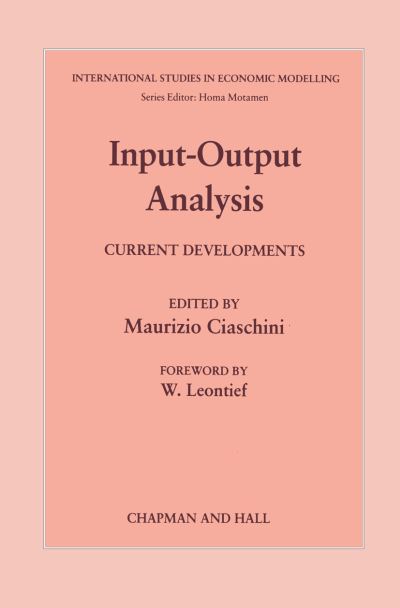
The twenty-two chapters included in this book were written by as many scholars working independently of each other in different countries. They present, nevertheless, a well integrated picture of systematic advance in the field of input-output analysis on the broad front, stretching from formal mathematical modelling, through construction of large, specialized databases to detailed empirical inquiry and concrete examples of practical applications. While reflecting a great variety of individual interests and working styles, these contributions taken together provide evidence of what might appear to be co- ordinated efforts. This coherence has not been brought about by the central guidance so typical of modern large-scale research. It simply reflects the internal discipline and cohesiveness of a particular methodological approach. In input-output analysis, empirical inquiry and theoretical model building have to be carried out hand-in-hand. If the aim of the investigation is to provide concrete, detailed explanation of observed reality, building an elaborate mathematical model makes little sense without an appropriate database. The language and the terminology used in the construction of that database must, however, be exactly the same as that employed in the formulation of the theoretical model. The same specifications and definitions must, of course, be adhered to - after the theoretical computations have been completed - in the interpretation of the numerical results.
| ISBN: | 9789401076760 |
| Publication date: | 5th October 2011 |
| Author: | M Giaschini |
| Publisher: | Springer an imprint of Springer Netherlands |
| Format: | Paperback |
| Pagination: | 414 pages |
| Series: | International Studies in Economic Modelling |
| Genres: |
Economics Mathematical modelling Maths for engineers |
The twenty-two chapters included in this book were written by as many scholars working independently of each other in different countries. They present, nevertheless, a well integrated picture of systematic advance in the field of input-output analysis on the broad front, stretching from formal mathematical modelling, through construction of large, specialized databases to detailed empirical inquiry and concrete examples of practical applications. While reflecting a great variety of individual interests and working styles, these contributions taken together provide evidence of what might appear to be co- ordinated efforts. This coherence has not been brought about by the central guidance so typical of modern large-scale research. It simply reflects the internal discipline and cohesiveness of a particular methodological approach. In input-output analysis, empirical inquiry and theoretical model building have to be carried out hand-in-hand. If the aim of the investigation is to provide concrete, detailed explanation of observed reality, building an elaborate mathematical model makes little sense without an appropriate database. The language and the terminology used in the construction of that database must, however, be exactly the same as that employed in the formulation of the theoretical model. The same specifications and definitions must, of course, be adhered to - after the theoretical computations have been completed - in the interpretation of the numerical results.
Input-Output Analysis features in the following genres: Economics, Mathematical modelling, Maths for engineers
Input-Output Analysis is available in Paperback
Input-Output Analysis was written by M Giaschini and published by Springer an imprint of Springer Netherlands
Input-Output Analysis has 414 pages
Yes it is part of International Studies in Economic Modelling series