

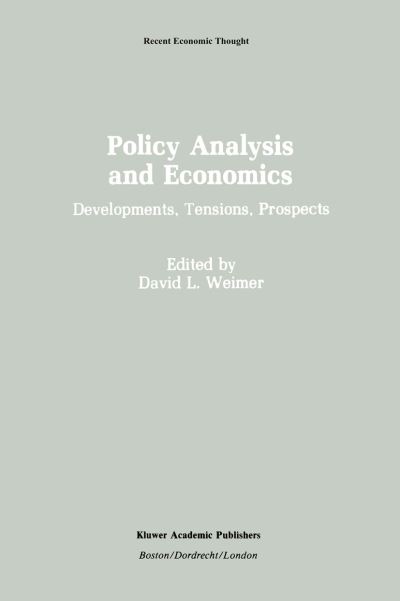
Long before policy analysis emerged as a separate profession with its own graduate schools, economists offered advice about government policies. Positive economics provides the tools for predicting the impacts of prop- osed policies; normative economics, especially welfare theory, offers a framework for valuing the impacts of policies in terms of efficiency and simple notions of equity. With the expansion of economic theory into ever wider fields of human behavior, it is no wonder that economists have prominence as teachers and practitioners of policy analysis.
Indeed, many economists see policy analysis as essentially applied economics. Though other social scientists might object to this somewhat parochial view, economics and policy analysis share much in commom in terms of develop- ment and prospects. The purpose of this volume is to trace these interrela- tionships and explore the tensions that they create.
Tensions arise for several reasons. Changes in the discipline of econ- omics affect the findings, methods, and personnel offered to policy analy- sis. For example, on the one hand, the "new institutional economics" appears to be extending the influence of economists to questions involving nonmarket oranizations, while on the other hand, the apparently growing emphasis within the economics profession on creating rather than empir- ically testing theory suggests that fewer of the best young scholars will be drawn to policy-relevant research.
Within the schools of policy analysis, the drift toward public management may reduce the demand for traditional economic training.
| ISBN: | 9789401057202 |
| Publication date: | 27th September 2012 |
| Author: | David L Weimer |
| Publisher: | Springer an imprint of Springer Netherlands |
| Format: | Paperback |
| Pagination: | 213 pages |
| Series: | Recent Economic Thought |
| Genres: |
Political economy Political science and theory Microeconomics |
Long before policy analysis emerged as a separate profession with its own graduate schools, economists offered advice about government policies. Positive economics provides the tools for predicting the impacts of prop- osed policies; normative economics, especially welfare theory, offers a framework for valuing the impacts of policies in terms of efficiency and simple notions of equity.
Policy Analysis and Economics features in the following genres: Political economy, Political science and theory, Microeconomics
Paperback. Not Available.
Policy Analysis and Economics was written by David L Weimer and published by Springer an imprint of Springer Netherlands
Policy Analysis and Economics has 213 pages
Yes it is part of Recent Economic Thought series