

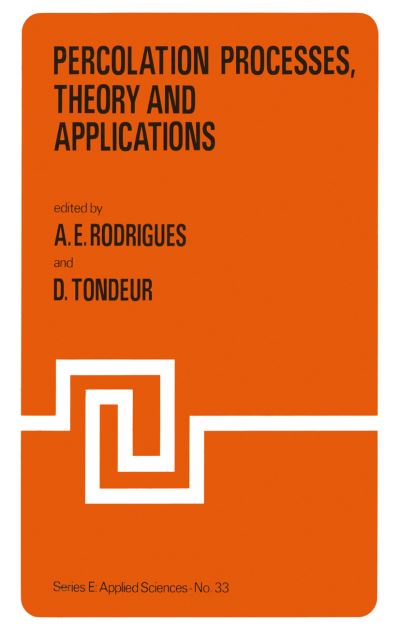
In a general way, "percolation" might be defined as a process in which at least two phases, one continuous and the other dispersed, are in bulk relative movement and exchange heat and/or mass through their interface. In practical terms this covers operations such as adsorption, ion exchange, leaching, washing, fluid-fluid displacement in po- rous media, deep bed filtration, chromatography. Apart from the fact that the design of these processes is almost empirical we have concluded to the necessity of organizing a Summer School on this topic because 1.
Powerful new concepts have emerged in this area in the last decade, centered around unsteady-state, non-linearly coupled, multi component systems, and low energy processes 2. There is, potentially, a phenomenologythat is common to all percolation operations, and which even extends to other mi- gration phenomena such as electrophoresis, sedimentation, traffic flow 3. There is a need for a synthetic and didatic approach to these problems and its spreading will be most fruitful for the de- velopment of separation science.
We have tried to choose lecturers who have, themselves, ma- de significant contributions toward the development of such an approach. The lectures given at the Summer School held at Espinho, Portugal in July 17-29, 1978 were compiled in this volume. It is VI divided in three parts.
In the first part some general and intro- ductory notions common to all operations are presented and chroma tography is analised in detail.
| ISBN: | 9789400985810 |
| Publication date: | 3rd November 2011 |
| Author: | AE Rodrigues, Daniel Tondeur |
| Publisher: | Springer an imprint of Springer Netherlands |
| Format: | Paperback |
| Pagination: | 596 pages |
| Series: | NATO Science Series E |
| Genres: |
Industrial chemistry and chemical engineering |
In a general way, "percolation" might be defined as a process in which at least two phases, one continuous and the other dispersed, are in bulk relative movement and exchange heat and/or mass through their interface. In practical terms this covers operations such as adsorption, ion exchange, leaching, washing, fluid-fluid displacement in po- rous media, deep bed filtration, chromatography.
Percolation Processes: features in the following genres: Industrial chemistry and chemical engineering
Paperback. Not Available.
Percolation Processes: was written by AE Rodrigues, Daniel Tondeur and published by Springer an imprint of Springer Netherlands
Percolation Processes: has 596 pages
Yes it is part of NATO Science Series E series