

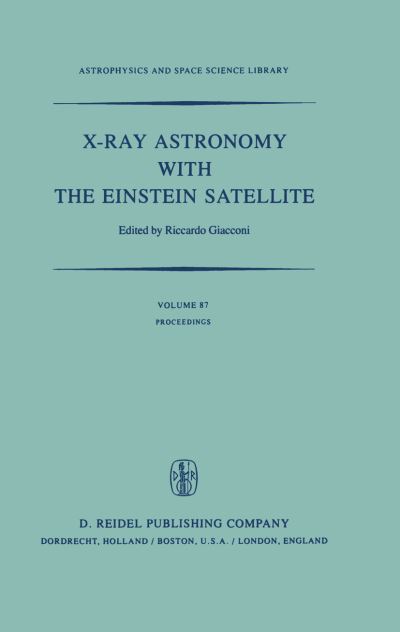
The meeting of the High Energy Astrophysics Division of the American Astronomical Society, held in Cambridge, Massachusetts on January 28- 30, 1980, marks the coming of age of X-ray astronomy. In the 18 years since the discovery of the first extrasolar X-ray source, Sco X-l, the field has experienced an extremely rapid instrumentation development culminating with the launch on November 13, 1978 of the Einstein Observatory (HEAO-2) which first introduced the use of high resolution imaging telescopes to the study of galactic and extragalactic X-ray sources.
The Einstein Observatory instruments can detect sources as faint as 10-7 Sco X-lor about 17 magnitudes fainter. The technological developments in the field have been paralleled by a host of new discoveries: in the early 1960's the detection of 9 "X-ray stars", objects 10 times more luminous in X-rays than the Sun and among the brightest stellar objects at all wavelengths; in the late 1960's and early 1970's the discovery of the natureof such systems which were identified as collapsed stars (neutron stars and black holes) in mass exchange binary systems, and the detection of the first few extragalactic sources.
| ISBN: | 9789400984615 |
| Publication date: | 8th December 2011 |
| Author: | R Giacconi |
| Publisher: | Springer an imprint of Springer Netherlands |
| Format: | Paperback |
| Pagination: | 330 pages |
| Series: | Astrophysics and Space Science Library |
| Genres: |
Astronomical observation: observatories, equipment and methods |
The meeting of the High Energy Astrophysics Division of the American Astronomical Society, held in Cambridge, Massachusetts on January 28- 30, 1980, marks the coming of age of X-ray astronomy. In the 18 years since the discovery of the first extrasolar X-ray source, Sco X-l, the field has experienced an extremely rapid instrumentation development culminating with the launch on November 13, 1978 of the Einstein Observatory (HEAO-2) which first introduced the use of high resolution imaging telescopes to the study of galactic and extragalactic X-ray sources.
X-Ray Astronomy With the Einstein Satellite features in the following genres: Astronomical observation: observatories, equipment and methods
Paperback. Not Available.
X-Ray Astronomy With the Einstein Satellite was written by R Giacconi and published by Springer an imprint of Springer Netherlands
X-Ray Astronomy With the Einstein Satellite has 330 pages
Yes it is part of Astrophysics and Space Science Library series