

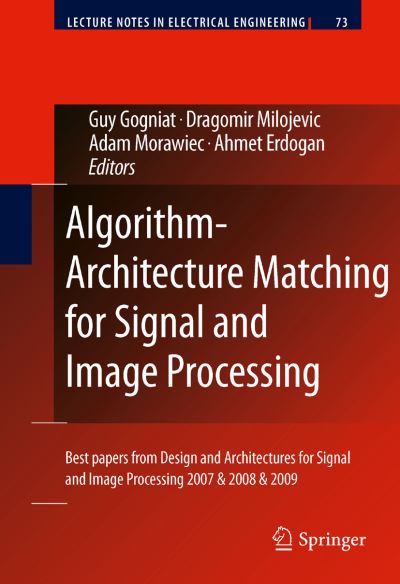
Advances in signal and image processing together with increasing computing power are bringing mobile technology closer to applications in a variety of domains like automotive, health, telecommunication, multimedia, entertainment and many others. The development of these leading applications, involving a large diversity of algorithms (e.g. signal, image, video, 3D, communication, cryptography) is classically divided into three consecutive steps: a theoretical study of the algorithms, a study of the target architecture, and finally the implementation. Such a linear design flow is reaching its limits due to intense pressure on design cycle and strict performance constraints. The approach, called Algorithm-Architecture Matching, aims to leverage design flows with a simultaneous study of both algorithmic and architectural issues, taking into account multiple design constraints, as well as algorithm and architecture optimizations, that couldn't be achieved otherwise if considered separately. Introducing new design methodologies is mandatory when facing the new emerging applications as for example advanced mobile communication or graphics using sub-micron manufacturing technologies or 3D-Integrated Circuits. This diversity forms a driving force for the future evolutions of embedded system designs methodologies.
The main expectations from system designers' point of view are related to methods, tools and architectures supporting application complexity and design cycle reduction. Advanced optimizations are essential to meet design constraints and to enable a wide acceptance of these new technologies.
Algorithm-Architecture Matching for Signal and Image Processing presents a collection of selected contributions from both industry and academia, addressing different aspects of Algorithm-Architecture Matching approach ranging from sensors to architectures design. The scope of this book reflects the diversity of potential algorithms, includingsignal, communication, image, video, 3D-Graphics implemented onto various architectures from FPGA to multiprocessor systems. Several synthesis and resource management techniques leveraging design optimizations are also described and applied to numerous algorithms.
Algorithm-Architecture Matching for Signal and Image Processing should be on each designer's and EDA tool developer's shelf, as well as on those with an interest in digital system design optimizations dealing with advanced algorithms.
| ISBN: | 9789048199648 |
| Publication date: | 28th October 2010 |
| Author: | Guy Gogniat |
| Publisher: | Springer an imprint of Springer Netherlands |
| Format: | Hardback |
| Pagination: | 296 pages |
| Series: | Lecture Notes in Electrical Engineering |
| Genres: |
Electronics engineering Algorithms and data structures Computer architecture and logic design Digital signal processing (DSP) |
Advances in signal and image processing together with increasing computing power are bringing mobile technology closer to applications in a variety of domains like automotive, health, telecommunication, multimedia, entertainment and many others. The development of these leading applications, involving a large diversity of algorithms (e.g. signal, image, video, 3D, communication, cryptography) is classically divided into three consecutive steps: a theoretical study of the algorithms, a study of the target architecture, and finally the implementation.
Algorithm-Architecture Matching for Signal and Image Processing features in the following genres: Electronics engineering, Algorithms and data structures, Computer architecture and logic design, Digital signal processing (DSP)
Hardback. Not Available.
Algorithm-Architecture Matching for Signal and Image Processing was written by Guy Gogniat and published by Springer an imprint of Springer Netherlands
Algorithm-Architecture Matching for Signal and Image Processing has 296 pages
Yes it is part of Lecture Notes in Electrical Engineering series