

In the last two decades modal logic has undergone an explosive growth, to thepointthatacompletebibliographyofthisbranchoflogic,supposingthat someone were capable to compile it, would ?ll itself a ponderous volume. What is impressive in the growth of modal logic has not been so much the quick accumulation of results but the richness of its thematic dev- opments.
In the 1960s, when Kripke semantics gave new credibility to the logic of modalities? which was already known and appreciated in the Ancient and Medieval times? no one could have foreseen that in a short time modal logic would become a lively source of ideas and methods for analytical philosophers,historians of philosophy,linguists, epistemologists and computer scientists.
The aim which oriented the composition of this book was not to write a new manual of modal logic (there are a lot of excellent textbooks on the market, and the expert reader will realize how much we bene?ted from manyofthem)buttoo?ertoeveryreader,evenwithnospeci?cbackground in logic, a conceptually linear path in the labyrinth of the current panorama of modal logic. The notion which in our opinion looked suitable to work as a compass in this enterprise was the notion of multimodality, or, more speci?cally, the basic idea of grounding systems on languages admitting more than one primitive modal operator.
| ISBN: | 9789048179244 |
| Publication date: | 30th November 2010 |
| Author: | Walter Carnielli, Claudio Pizzi |
| Publisher: | Springer an imprint of Springer Netherlands |
| Format: | Paperback |
| Pagination: | 304 pages |
| Series: | Logic, Epistemology, and the Unity of Science |
| Genres: |
Philosophy: logic Mathematical logic Mathematical foundations Philosophical traditions and schools of thought Mathematical theory of computation Philosophy |
In the last two decades modal logic has undergone an explosive growth, to thepointthatacompletebibliographyofthisbranchoflogic,supposingthat someone were capable to compile it, would ?ll itself a ponderous volume. What is impressive in the growth of modal logic has not been so much the quick accumulation of results but the richness of its thematic dev- opments.
Modalities and Multimodalities features in the following genres: Philosophy: logic, Mathematical logic, Mathematical foundations, Philosophical traditions and schools of thought, Mathematical theory of computation, Philosophy
Paperback. Not Available.
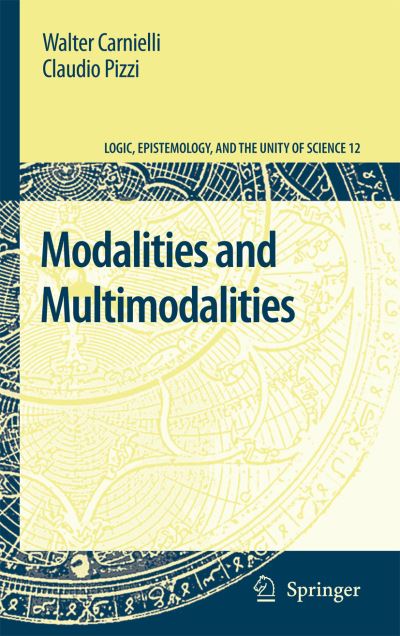
Modalities and Multimodalities was written by Walter Carnielli, Claudio Pizzi and published by Springer an imprint of Springer Netherlands
Modalities and Multimodalities has 304 pages
Yes it is part of Logic, Epistemology, and the Unity of Science series