

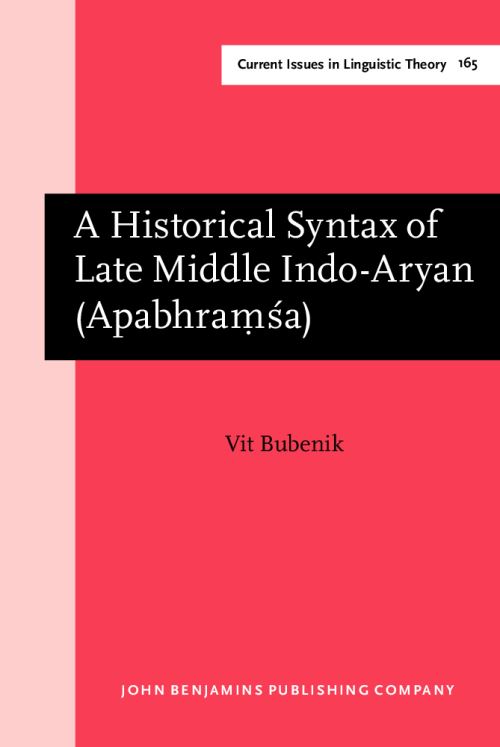
This monograph aims to close the gap in our knowledge of the nature and pace of grammatical change during the formative period of today's Indo-Aryan languages. During the 6th-12th c. the gradual erosion of the synthetic morphology of Old Indo-Aryan resulted ultimately in the remodelling of its syntax in the direction of the New Indo-Aryan analytic type.
This study concentrates on the emergence and development of the ergative construction in terms of the passive-to-ergative reanalysis and the co-existence of the ergative construction with the old and new analytic passive constructions.
Special attention is paid to the actuation problem seen as the tug of war between conservative and eliminative forces during their development. Other chapters deal with the evolution of grammatical and lexical aspect, causativization, modality, absolute constructions and subordination. This study is based on a wealth of new data gleaned from original poetic works in Apabhram a (by Svayam bh deva, Pus padanta, Haribhadra, Somaprabha et al.).
It contains sections dealing with descriptive techniques of Medieval Indian grammarians (esp. Hemacandra). All the Sanskrit, Prakrit and Apabhram a examples are consistently parsed and translated.
The opus is cast in the theoretical framework of Functional Grammar of the Prague and Amsterdam Schools. It should be of particular interest to scholars and students of Indo-Aryan and general historical linguistics, especially those interested in the issues of morphosyntactic change and typology in their sociohistorical setting.
| ISBN: | 9789027236708 |
| Publication date: | 15th October 1998 |
| Author: | Vit Bubenik |
| Publisher: | John Benjamins Publishing Company |
| Format: | Hardback |
| Pagination: | 291 pages |
| Series: | Current Issues in Linguistic Theory |
| Genres: |
Linguistics |
This monograph aims to close the gap in our knowledge of the nature and pace of grammatical change during the formative period of today's Indo-Aryan languages. During the 6th-12th c. the gradual erosion of the synthetic morphology of Old Indo-Aryan resulted ultimately in the remodelling of its syntax in the direction of the New Indo-Aryan analytic type.
A Historical Syntax of Late Middle Indo-Aryan (Apabhram A) features in the following genres: Linguistics
Hardback. Not Available.
A Historical Syntax of Late Middle Indo-Aryan (Apabhram A) was written by Vit Bubenik and published by John Benjamins Publishing Company
A Historical Syntax of Late Middle Indo-Aryan (Apabhram A) has 291 pages
Yes it is part of Current Issues in Linguistic Theory series