

The focus is on the inter action between demand and supply in a small open economy featuring the dynamics of private capital, public debt and foreign assets. The overlapping generations model serves as a microfoundation. It proves useful to consider different scenarios.
Exchange rates are either flexible or fixed. Money wages can be flexible, fixed or slow. Monetary and fiscal policy may be exogenous or endo- genous.
Either budget deficits are allowed, or continuous budget balance is postula- ted. Wh at are the implications of various shocks? How does the chain of cause and effect look like?
I had many helpful talks with my colleagues at Hamburg: Michael Schmid (now at Bamberg), Wolf Schäfer and Johannes Hackmann. In addition, Daphni-Marina Papadopoulou and Christine Schäfer-Lochte carefully discussed with me all parts of the manuscript. Last but not least, Doris Ehrich typed the manuscript as excellently as ever.
I would like to thank all of them. CONTENTS INTRODUCTION 3 PART 1.
FLEXIBLE EXCHANGE RATES
11 CHAPTER 1. BASIC MODEL 11 1. Flexible Money Wages 13 13 1. 1.
Overlapping Generations 1. 2. Short-Run Equilibrium and Long-Run Equilibrium 23 1. 3. Stability 27 1. 4.
Shoeks 30 2. Fixed Money Wages 34 34 2. 1. Overlapping Generations 2. 2.
Short-Run Equilibrium and Long-Run Equilibrium 39 2. 3. Stability 41 2. 4. Shoeks 44 3.
Slow Money Wages 52 3. 1. Special Case 1= 0 52 3. 2. General Case 60 4.
Monetary Poliey 64 4. 1.
| ISBN: | 9783790807080 |
| Publication date: | 30th August 1993 |
| Author: | Michael Carlberg |
| Publisher: | Physica an imprint of Physica-Verlag HD |
| Format: | Paperback |
| Pagination: | 203 pages |
| Series: | Contributions to Economics |
| Genres: |
International economics |
The focus is on the inter action between demand and supply in a small open economy featuring the dynamics of private capital, public debt and foreign assets. The overlapping generations model serves as a microfoundation.
Open Economy Dynamics features in the following genres: International economics
Paperback. Not Available.
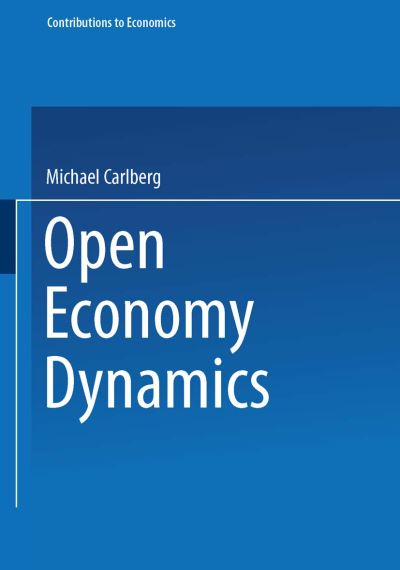
Open Economy Dynamics was written by Michael Carlberg and published by Physica an imprint of Physica-Verlag HD
Open Economy Dynamics has 203 pages
Yes it is part of Contributions to Economics series