

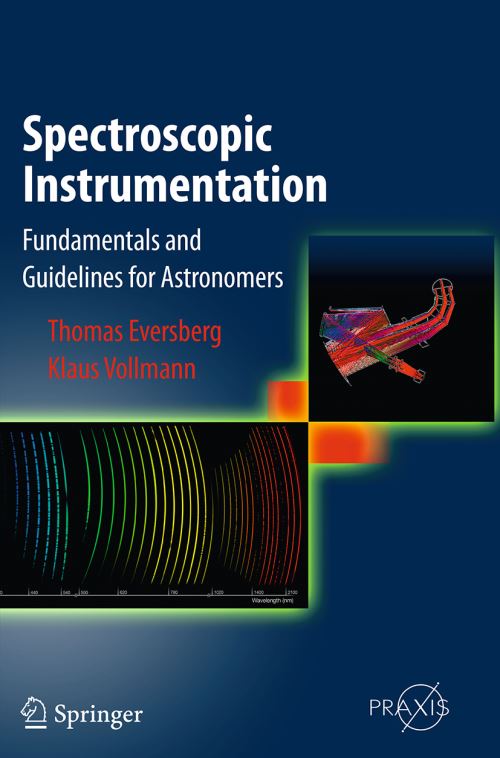
In order to analyze the light of cosmic objects, particularly at extremely great distances, spectroscopy is the workhorse of astronomy. In the era of very large telescopes, long-term investigations are mainly performed with small professional instruments. Today they can be done using self-designed spectrographs and highly efficient CCD cameras, without the need for large financial investments.
This book explains the basic principles of spectroscopy, including the fundamental optical constraints and all mathematical aspects needed to understand the working principles in detail. It covers the complete theoretical and practical design of standard and Echelle spectrographs. Readers are guided through all necessary calculations, enabling them to engage in spectrograph design.
The book also examines data acquisition with CCD cameras and fiber optics, as well as the constraints of specific data reduction and possible sources of error. In closing it briefly highlights some main aspects of the research on massive stars and spectropolarimetry as an extension of spectroscopy. The book offers a comprehensive introduction to spectroscopy for students of physics and astronomy, as well as a valuable resource for amateur astronomers interested in learning the principles of spectroscopy and spectrograph design.
| ISBN: | 9783662511527 |
| Publication date: | 23rd August 2016 |
| Author: | Thomas Eversberg, Klaus Vollmann |
| Publisher: | Springer an imprint of Springer Berlin Heidelberg |
| Format: | Paperback |
| Pagination: | 653 pages |
| Series: | Springer-Praxis Books in Astronomy and Planetary Sciences |
| Genres: |
Astronomical observation: observatories, equipment and methods Laser physics Electronics engineering |
In order to analyze the light of cosmic objects, particularly at extremely great distances, spectroscopy is the workhorse of astronomy. In the era of very large telescopes, long-term investigations are mainly performed with small professional instruments.
Spectroscopic Instrumentation features in the following genres: Astronomical observation: observatories, equipment and methods, Laser physics, Electronics engineering
Paperback, Hardback. Not Available.
Spectroscopic Instrumentation was written by Thomas Eversberg, Klaus Vollmann and published by Springer an imprint of Springer Berlin Heidelberg
Spectroscopic Instrumentation has 653 pages
Yes it is part of Springer-Praxis Books in Astronomy and Planetary Sciences series