

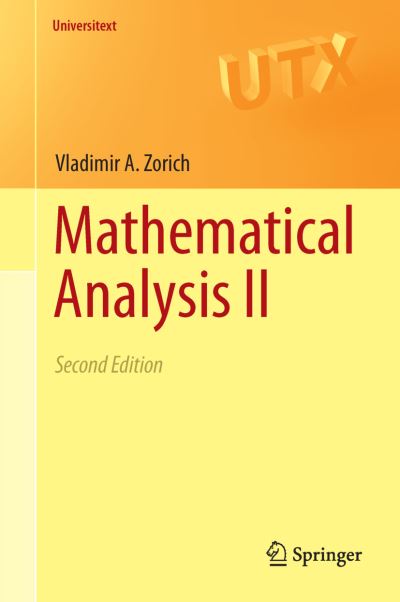
This second English edition of a very popular two-volume work presents a thorough first course in analysis, leading from real numbers to such advanced topics as differential forms on manifolds; asymptotic methods; Fourier, Laplace, and Legendre transforms; elliptic functions; and distributions. Especially notable in this course are the clearly expressed orientation toward the natural sciences and the informal exploration of the essence and the roots of the basic concepts and theorems of calculus. Clarity of exposition is matched by a wealth of instructive exercises, problems, and fresh applications to areas seldom touched on in textbooks on real analysis.
The main difference between the second and first English editions is the addition of a series of appendices to each volume. There are six of them in the first volume and five in the second. The subjects of these appendices are diverse. They are meant to be useful to both students (in mathematics and physics) and teachers, who may be motivated by different goals. Some of the appendices are surveys, both prospective and retrospective. The final survey establishes important conceptual connections between analysis and other parts of mathematics.
This second volume presents classical analysis in its current form as part of a unified mathematics. It shows how analysis interacts with other modern fields of mathematics such as algebra, differential geometry, differential equations, complex analysis, and functional analysis. This book provides a firm foundation for advanced work in any of these directions.
| ISBN: | 9783662489918 |
| Publication date: | 22nd February 2016 |
| Author: | V A Zorich |
| Publisher: | Springer an imprint of Springer Berlin Heidelberg |
| Format: | Hardback |
| Pagination: | 720 pages |
| Series: | Universitext |
| Genres: |
Calculus and mathematical analysis Mathematical physics |
This second English edition of a very popular two-volume work presents a thorough first course in analysis, leading from real numbers to such advanced topics as differential forms on manifolds; asymptotic methods; Fourier, Laplace, and Legendre transforms; elliptic functions; and distributions. Especially notable in this course are the clearly expressed orientation toward the natural sciences and the informal exploration of the essence and the roots of the basic concepts and theorems of calculus.
Mathematical Analysis II features in the following genres: Calculus and mathematical analysis, Mathematical physics
Hardback. £71.99, down from the £79.99 cover price. Not Available.
Mathematical Analysis II was written by V A Zorich and published by Springer an imprint of Springer Berlin Heidelberg
Mathematical Analysis II has 720 pages
Yes it is part of Universitext series
£71.99, reduced from £79.99. Not Available.