

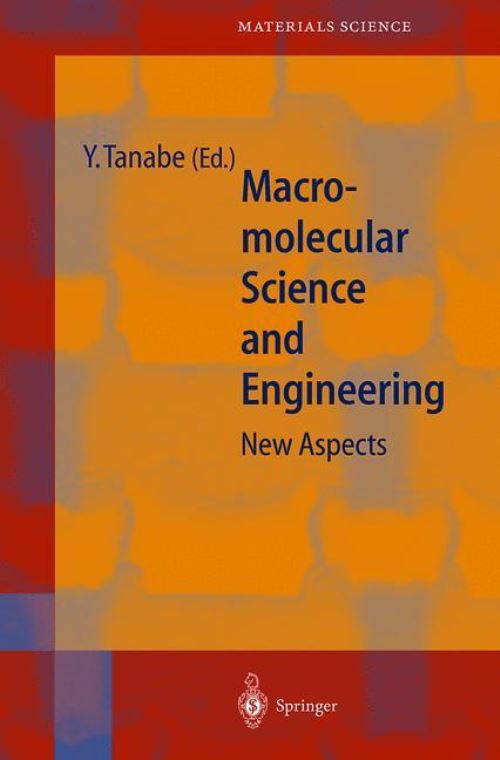
The explosion in the scale of production of polymers has made our daily life more convenient during the past several decades, and caused serious discus- sion on recycling and safety. During this time, many polymer researchers who have constructed new industries and new fields of science changed their interests to specialty polymers and some have moved to bioscience. On the other hand, the expected limitations of silicon devices, which are fundamen- tal in the present semiconductor and personal computer world, have initiated much interest in the idea of molecular electronic devices.
Based on this idea, ultrathin films with many functions were studied, but it is still difficult to use them in real information systems. In these studies, polymer scientists and solid state physicists collaborated with each other and the new field of conju- gated materials, including charge-transfer-complexes, conjugated conductive materials and fullerenes, has grown. Here, optical properties are the main interest because new materials are necessary in the advanced information so- ciety of the twenty first century.
During the course of this development, the boundary between polymers and small organic molecules has become blurred, except for the synthetic chemists. This new field of science and engineering is growing and will propose new materials and new devices. The present book aims at a compact presentation of the principal con- cepts in current polymeric and organic materials science and engineering.
| ISBN: | 9783642636455 |
| Publication date: | 1st November 2012 |
| Author: | Yoshikazu Tanabe |
| Publisher: | Springer an imprint of Springer Berlin Heidelberg |
| Format: | Paperback |
| Pagination: | 401 pages |
| Series: | Springer Series in Materials Science |
| Genres: |
Testing of materials Engineering applications of polymers and composites Materials science |
The explosion in the scale of production of polymers has made our daily life more convenient during the past several decades, and caused serious discus- sion on recycling and safety. During this time, many polymer researchers who have constructed new industries and new fields of science changed their interests to specialty polymers and some have moved to bioscience.
Macromolecular Science and Engineering features in the following genres: Testing of materials, Engineering applications of polymers and composites, Materials science
Paperback. Not Available.
Macromolecular Science and Engineering was written by Yoshikazu Tanabe and published by Springer an imprint of Springer Berlin Heidelberg
Macromolecular Science and Engineering has 401 pages
Yes it is part of Springer Series in Materials Science series