

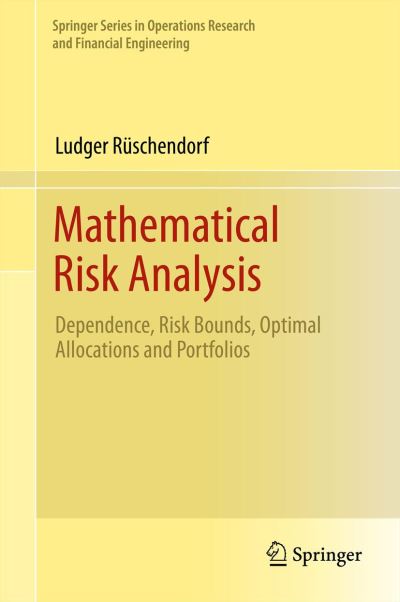
The author's particular interest in the area of risk measures is to combine this theory with the analysis of dependence properties. The present volume gives an introduction of basic concepts and methods in mathematical risk analysis, in particular of those parts of risk theory that are of special relevance to finance and insurance. Describing the influence of dependence in multivariate stochastic models on risk vectors is the main focus of the text that presents main ideas and methods as well as their relevance to practical applications.
The first part introduces basic probabilistic tools and methods of distributional analysis, and describes their use to the modeling of dependence and to the derivation of risk bounds in these models. In the second, part risk measures with a particular focus on those in the financial and insurance context are presented. The final parts are then devoted to applications relevant to optimal risk allocation, optimal portfolio problems as well as to the optimization of insurance contracts.
Good knowledge of basic probability and statistics as well as of basic general mathematics is a prerequisite for comfortably reading and working with the present volume, which is intended for graduate students, practitioners and researchers and can serve as a reference resource for the main concepts and techniques.
| ISBN: | 9783642430169 |
| Publication date: | 12th April 2015 |
| Author: | Ludger Rüschendorf |
| Publisher: | Springer an imprint of Springer Berlin Heidelberg |
| Format: | Paperback |
| Pagination: | 408 pages |
| Series: | Springer Series in Operations Research and Financial Engineering |
| Genres: |
Probability and statistics Insurance and actuarial studies Stochastics Operational research Applied mathematics Economics, Finance, Business and Management |
The author's particular interest in the area of risk measures is to combine this theory with the analysis of dependence properties. The present volume gives an introduction of basic concepts and methods in mathematical risk analysis, in particular of those parts of risk theory that are of special relevance to finance and insurance.
Mathematical Risk Analysis features in the following genres: Probability and statistics, Insurance and actuarial studies, Stochastics, Operational research, Applied mathematics, Economics, Finance, Business and Management
Paperback, Hardback. Not Available.
Mathematical Risk Analysis was written by Ludger Rüschendorf and published by Springer an imprint of Springer Berlin Heidelberg
Mathematical Risk Analysis has 408 pages
Yes it is part of Springer Series in Operations Research and Financial Engineering series