

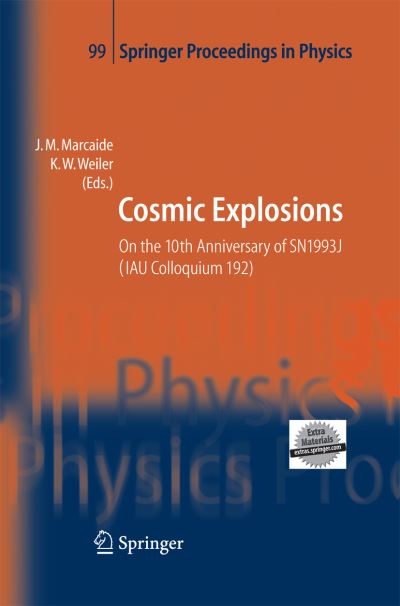
Supernovae are among the most energetic phenomena in the Universe and - lated to almost all aspects of modern astrophysics including starburst gal- ies, cosmic ray acceleration, neutron star and black hole formation, nuc- osynthesis and ISM chemical enrichment, energy input to the ISM, cosmic distance scale determination, dark energy related cosmological acceleration, gamma-ray bursts, extra-solar system neutrino burst detection, gravity wave generation, and many more.
Additionally, the past 15 years have been p- ticularly productive with many new results and new understanding due in particular to the closest SN in 400 years in SN 1987A in the Large M- ellanic Cloud, and the unusually bright and close SN 1993J and SN 1994I in the nearby galaxies M81 and M51, respectively. In addition, the disc- ery of the ?-ray burst GRB 980425 and its related supernova SN 1998bw, and the con?rmation of GRB 030329/SN 2003dh, tied the study of SNe and GRBs inextricably together.
With the many developments since the last - jor supernova meeting in La Serena, Chile in 1997, we felt that it was an appropriate time to bring together experts and students interested in the subject for a meeting where SN and GRB properties and interrelationships could be discussed. The tenth anniversary of SN 1993J provided such an - portunity and, appropriately, the meeting was held in Spain where SN 1993J was discovered on the early morning of 28 March 1993 by a Spanish amateur astronomer, Francisco Garc´ ?a.
| ISBN: | 9783642421877 |
| Publication date: | 28th November 2014 |
| Author: | JM Marcaide, Kurt Weiler |
| Publisher: | Springer an imprint of Springer Berlin Heidelberg |
| Format: | Paperback |
| Pagination: | 593 pages |
| Series: | Springer Proceedings in Physics |
| Genres: |
Astronomy, space and time |
Supernovae are among the most energetic phenomena in the Universe and - lated to almost all aspects of modern astrophysics including starburst gal- ies, cosmic ray acceleration, neutron star and black hole formation, nuc- osynthesis and ISM chemical enrichment, energy input to the ISM, cosmic distance scale determination, dark energy related cosmological acceleration, gamma-ray bursts, extra-solar system neutrino burst detection, gravity wave generation, and many more. Additionally, the past 15 years have been p- ticularly productive with many new results and new understanding due in particular to the closest SN in 400 years in SN 1987A in the Large M- ellanic Cloud, and the unusually bright and close SN 1993J and SN 1994I in the nearby galaxies M81 and M51, respectively.
Cosmic Explosions features in the following genres: Astronomy, space and time
Paperback, Hardback. Not Available.
Cosmic Explosions was written by JM Marcaide, Kurt Weiler and published by Springer an imprint of Springer Berlin Heidelberg
Cosmic Explosions has 593 pages
Yes it is part of Springer Proceedings in Physics series