

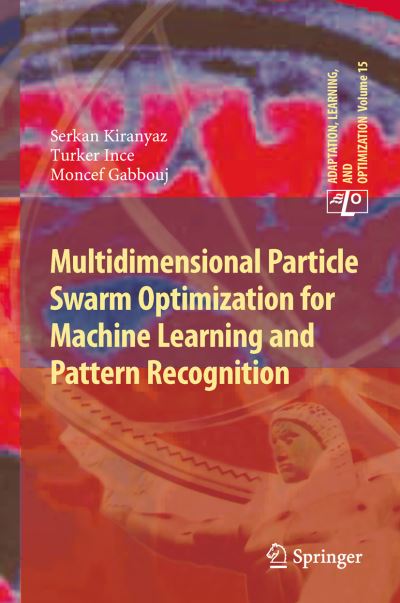
For many engineering problems we require optimization processes with dynamic adaptation as we aim to establish the dimension of the search space where the optimum solution resides and develop robust techniques to avoid the local optima usually associated with multimodal problems. This book explores multidimensional particle swarm optimization, a technique developed by the authors that addresses these requirements in a well-defined algorithmic approach.
After an introduction to the key optimization techniques, the authors introduce their unified framework and demonstrate its advantages in challenging application domains, focusing on the state of the art of multidimensional extensions such as global convergence in particle swarm optimization, dynamic data clustering, evolutionary neural networks, biomedical applications and personalized ECG classification, content-based image classification and retrieval, and evolutionary feature synthesis. The content is characterizedby strong practical considerations, and the book is supported with fully documented source code for all applications presented, as well as many sample datasets.
The book will be of benefit to researchers and practitioners working in the areas of machine intelligence, signal processing, pattern recognition, and data mining, or using principles from these areas in their application domains. It may also be used as a reference text for graduate courses on swarm optimization, data clustering and classification, content-based multimedia search, and biomedical signal processing applications.
| ISBN: | 9783642378454 |
| Publication date: | 30th July 2013 |
| Author: | Serkan Kiranyaz, Turker Ince, Moncef Gabbouj |
| Publisher: | Springer an imprint of Springer Berlin Heidelberg |
| Format: | Hardback |
| Pagination: | 321 pages |
| Series: | Adaptation, Learning, and Optimization |
| Genres: |
Artificial intelligence Electrical engineering |
For many engineering problems we require optimization processes with dynamic adaptation as we aim to establish the dimension of the search space where the optimum solution resides and develop robust techniques to avoid the local optima usually associated with multimodal problems. This book explores multidimensional particle swarm optimization, a technique developed by the authors that addresses these requirements in a well-defined algorithmic approach. After an introduction to the key optimization techniques, the authors introduce their unified framework and demonstrate its advantages in challenging application domains, focusing on the state of the art of multidimensional extensions such as global convergence in particle swarm optimization, dynamic data clustering, evolutionary neural networks, biomedical applications and personalized ECG classification, content-based image classification and retrieval, and evolutionary feature synthesis.
Multidimensional Particle Swarm Optimization for Machine Learning and Pattern Recognition features in the following genres: Artificial intelligence, Electrical engineering
Hardback. Not Available.
Multidimensional Particle Swarm Optimization for Machine Learning and Pattern Recognition was written by Serkan Kiranyaz, Turker Ince, Moncef Gabbouj and published by Springer an imprint of Springer Berlin Heidelberg
Multidimensional Particle Swarm Optimization for Machine Learning and Pattern Recognition has 321 pages
Yes it is part of Adaptation, Learning, and Optimization series