

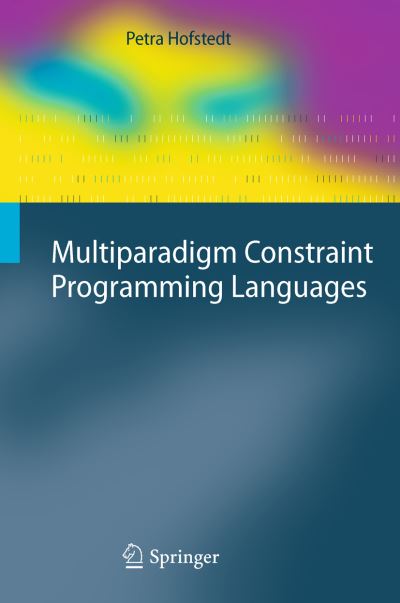
Programming languages are often classified according to their paradigms, e.g. imperative, functional, logic, constraint-based, object-oriented, or aspect-oriented. A paradigm characterizes the style, concepts, and methods of the language for describing situations and processes and for solving problems, and each paradigm serves best for programming in particular application areas. Real-world problems, however, are often best implemented by a combination of concepts from different paradigms, because they comprise aspects from several realms, and this combination is more comfortably realized using multiparadigm programming languages.
This book deals with the theory and practice of multiparadigm constraint programming languages. The author first elaborates on programming paradigms and languages, constraints, and the merging of programming concepts which yields multiparadigm (constraint) programming languages. In the second part the author inspects two concrete approaches on multiparadigm constraint programming - the concurrent constraint functional language CCFL, which combines the functional and the constraint-based paradigms and allows the description of concurrent processes; and a general framework for multiparadigm constraint programming and its implementation, Meta-S.
The book is appropriate for researchers and graduate students in the areas of programming and artificial intelligence.
| ISBN: | 9783642173295 |
| Publication date: | 17th June 2011 |
| Author: | Petra Hofstedt |
| Publisher: | Springer an imprint of Springer Berlin Heidelberg |
| Format: | Hardback |
| Pagination: | 180 pages |
| Series: | Cognitive Technologies |
| Genres: |
Artificial intelligence Computer programming / software engineering |
Programming languages are often classified according to their paradigms, e.g. imperative, functional, logic, constraint-based, object-oriented, or aspect-oriented. A paradigm characterizes the style, concepts, and methods of the language for describing situations and processes and for solving problems, and each paradigm serves best for programming in particular application areas.
Multiparadigm Constraint Programming Languages features in the following genres: Artificial intelligence, Computer programming / software engineering
Hardback. Not Available.
Multiparadigm Constraint Programming Languages was written by Petra Hofstedt and published by Springer an imprint of Springer Berlin Heidelberg
Multiparadigm Constraint Programming Languages has 180 pages
Yes it is part of Cognitive Technologies series