

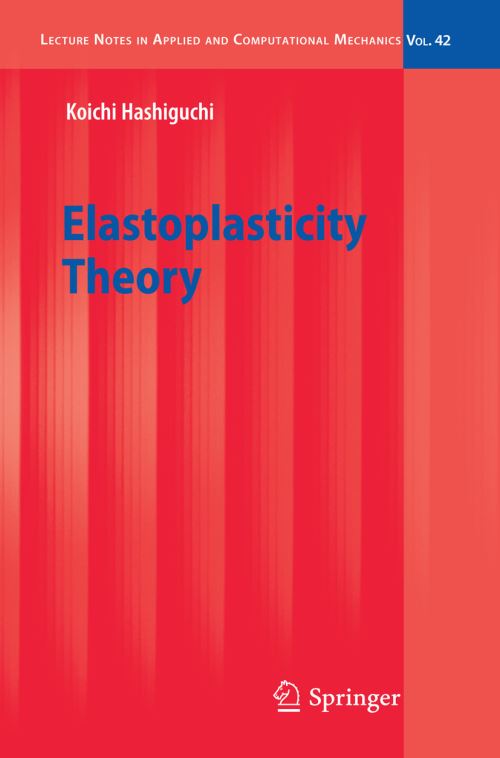
Contents Recent advancements in the performance of industrial products and structures are quite intense. Consequently, mechanical design of high accuracy is necessary to enhance their mechanical performance, strength and durability. The basis for their mechanical design can be provided through elastoplastic deformation analyses.
For that reason, industrial engineers in the fields of mechanical, civil, architec- ral, aerospace engineering, etc. must learn pertinent knowledge relevant to elas- plasticity. Numerous books about elastoplasticity have been published since "Mathema- cal Theory of Plasticity", the notable book of R. Hill (1950), was written in the middle of the last century.
That and similar books mainly address conventional plasticity models on the premise that the interior of a yield surface is an elastic domain. However, conventional plasticity models are applicable to the prediction of monotonic loading behavior, but are inapplicable to prediction of deformation behavior of machinery subjected to cyclic loading and civil or architectural str- tures subjected to earthquakes. Elastoplasticity has developed to predict defor- tion behavior under cyclic loading and non-proportional loading and to describe nonlocal, finite and rate-dependent deformation behavior.
| ISBN: | 9783642101328 |
| Publication date: | 22nd October 2010 |
| Author: | Koichi Hashiguchi |
| Publisher: | Springer an imprint of Springer Berlin Heidelberg |
| Format: | Paperback |
| Pagination: | 416 pages |
| Series: | Lecture Notes in Applied and Computational Mechanics |
| Genres: |
Engineering: Mechanics of solids Artificial intelligence Classical mechanics Mathematical physics |
Contents Recent advancements in the performance of industrial products and structures are quite intense. Consequently, mechanical design of high accuracy is necessary to enhance their mechanical performance, strength and durability.
Elastoplasticity Theory features in the following genres: Engineering: Mechanics of solids, Artificial intelligence, Classical mechanics, Mathematical physics
Hardback, Paperback. Not Available.
Elastoplasticity Theory was written by Koichi Hashiguchi and published by Springer an imprint of Springer Berlin Heidelberg
Elastoplasticity Theory has 416 pages
Yes it is part of Lecture Notes in Applied and Computational Mechanics series