

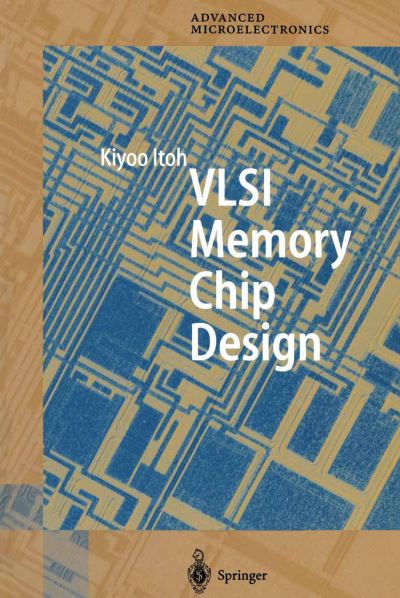
The VLSI memory era truly began when the first production of semiconduc- tor memory was announced by IBM and Intel in 1970. The announcement had a profound impact on my research at Hitachi Ltd. , and I was forced to change fields: from magnetic thin film to semiconductor memory. This change was so exceptionally sudden and difficult, I feIt like a victim of fate.
Looking back, however, I realize how fortunate I was. I have witnessed an unprecedented increase in memory capacity (DRAM, for example, has had a 6-order increase in the last three decades - from the 1-Kb level in 1970 to the 1-Gb level today). I have contributed to this progress with full involvement in memory-chip development over my career.
Such rapid progress would have been impossible without many of the inventions and innovative technologies, and without the effort of many talented people. Unfortunately, few systematic books on memory-chip design have been written by experts. Tliis is a result of two factors: the difficulty of involving university professors because of rapidly changing technology requiring huge investments and development resources, and a shortage of time on the part of chip designers in industry due to severe competition in the memory-chip business.
Therefore, LSI memory-chip design has been isolated from the outside, preventing a deeper understanding of the technology. This book is based on my 30-year memory-chip (particularly DRAM) design career.
| ISBN: | 9783642087363 |
| Publication date: | 10th November 2010 |
| Author: | Kiyoo Itoh |
| Publisher: | Springer an imprint of Springer Berlin Heidelberg |
| Format: | Paperback |
| Pagination: | 495 pages |
| Series: | Springer Series in Advanced Microelectronics |
| Genres: |
Electronics engineering Engineering applications of electronic, magnetic, optical materials Mathematical theory of computation Engineering: general Nanotechnology |
The VLSI memory era truly began when the first production of semiconduc- tor memory was announced by IBM and Intel in 1970. The announcement had a profound impact on my research at Hitachi Ltd. , and I was forced to change fields: from magnetic thin film to semiconductor memory.
VLSI Memory Chip Design features in the following genres: Electronics engineering, Engineering applications of electronic, magnetic, optical materials, Mathematical theory of computation, Engineering: general, Nanotechnology
Paperback, Hardback. Not Available.
VLSI Memory Chip Design was written by Kiyoo Itoh and published by Springer an imprint of Springer Berlin Heidelberg
VLSI Memory Chip Design has 495 pages
Yes it is part of Springer Series in Advanced Microelectronics series