

Shall we be destined to the days of eternity, on holy-days,as well as working days, to be shewing the RELICKS OF LEARNING, as monks do the relicks of their saints - without working one - one single miracle with them? Laurence Sterne, Tristram Shandy This book deals with information processing; so it is far from being a book on information theory (which would be built on description and estimation). The reader will be shown the horse, but not the saddle.
At any rate, at the very beginning, there was a series of lectures on "Information theory, through the looking-glass of an algebraist", and, as years went on, a steady process of teaching and learning made the material evolve into the present form. There still remains an algebraic main theme: algorithms intertwining polynomial algebra and matrix algebra, in the shelter of signal theory. A solid knowledge of elementary arithmetic and Linear Algebra will be the key to a thorough understanding of all the algorithms working in the various bit-stream landscapes we shall encounter.
This priority of algebra will be the thesis that we shall defend. More concretely: We shall treat, in ?ve chapters of increasing di?culty, ?ve sensibly di?erent subjects in Discrete Mathem- ics. The?rsttwochaptersondatacompaction(losslessdatacompression)and cryptography are on an undergraduate level - the most di?cult mathematical prerequisite will be a sound understanding of quotient rings, especially of- nite ?elds (mostly in characteristic 2).
| ISBN: | 9783642069789 |
| Publication date: | 30th November 2010 |
| Author: | Peter Seibt |
| Publisher: | Springer an imprint of Springer Berlin Heidelberg |
| Format: | Paperback |
| Pagination: | 443 pages |
| Series: | Signals and Communication Technology |
| Genres: |
Algorithms and data structures Maths for computer scientists Cybernetics and systems theory Coding theory and cryptology Discrete mathematics Maths for engineers Electronics engineering Digital signal processing (DSP) Information theory |
Shall we be destined to the days of eternity, on holy-days,as well as working days, to be shewing the RELICKS OF LEARNING, as monks do the relicks of their saints - without working one - one single miracle with them? Laurence Sterne, Tristram Shandy This book deals with information processing; so it is far from being a book on information theory (which would be built on description and estimation).
Algorithmic Information Theory features in the following genres: Algorithms and data structures, Maths for computer scientists, Cybernetics and systems theory, Coding theory and cryptology, Discrete mathematics, Maths for engineers, Electronics engineering, Digital signal processing (DSP), Information theory
Paperback, Hardback. Not Available.
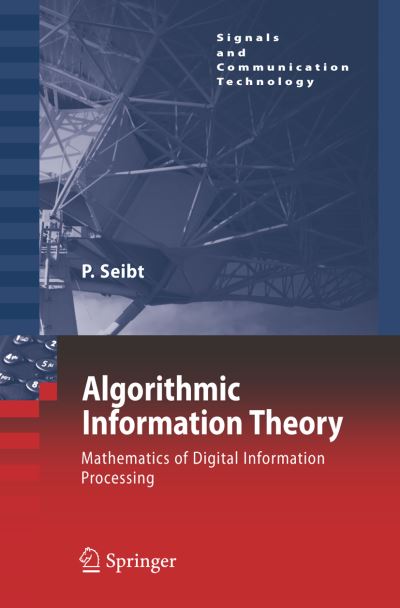
Algorithmic Information Theory was written by Peter Seibt and published by Springer an imprint of Springer Berlin Heidelberg
Algorithmic Information Theory has 443 pages
Yes it is part of Signals and Communication Technology series