

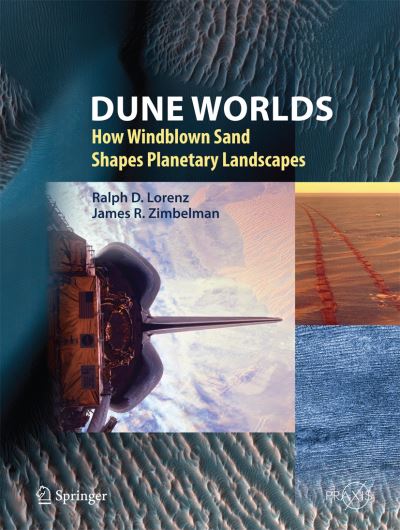
This book describes how sand dunes work, why they are the way they are in different settings, and how they are being studied. Particular attention is paid to their formation and appearance elsewhere in the solar system. New developments in knowledge about dunes make for an interesting story - like the dunes themselves, dune science is dynamic - and the visual appeal of Aeolian geomorphology ensures that this is an attractive volume.
The book is divided into 4 parts, the first of which introduces dunes as a planetary phenomenon, showing a landscape reflecting the balance of geological processes - volcanism, impact, tectonics, erosion, deposition of sediments. Dunes are then considered as emergent dynamical systems: the interaction of sand and wind conspires to generate very characteristic and reproducible shapes. Analogies are given with other emergent structures such as patterned ground before the influence of dunes on desert peoples and infrastructure is studied, together with their use as forensic climatological indicators.
Dune Physics is looked at with regard to the mechanics of sand, the physics of wind, saltation - interaction of sand and air - dunes versus ripples and transverse Aeolian ridges, the classification of dune morphology and the sources and sinks of sand. Dune Trafficability considers soil mechanics, effects on mobility on Earth, Mars and elsewhere.
In the second part, Earth, Mars, Titan and other moons and planets are examined, beginning with a survey of the major deserts and dunefields on Earth. The authors then turn to Mars and its environment, sediment type, dune stratigraphy, sediment source and sinks and the association of dunes with topographic features.
Titan follows - its thick, cold atmosphere, methane dampness, low gravity, morphology - interaction with topography and the implications of dunes for climate and winds. Dunes elsewhere conclude this part. There are few dunefields on Venus, but there is a .possibility ofAeolian transport on Triton and volcanic-related windstreaks on Io.
| ISBN: | 9783540897248 |
| Publication date: | 6th May 2014 |
| Author: | Ralph Lorenz, James R Zimbelman |
| Publisher: | Springer an imprint of Springer Berlin Heidelberg |
| Format: | Hardback |
| Pagination: | 308 pages |
| Series: | Springer-Praxis Books in Geophysical Sciences |
| Genres: |
Astronomy, space and time Earth sciences |
This book describes how sand dunes work, why they are the way they are in different settings, and how they are being studied. Particular attention is paid to their formation and appearance elsewhere in the solar system.
Dune Worlds features in the following genres: Astronomy, space and time, Earth sciences
Hardback. Not Available.
Dune Worlds was written by Ralph Lorenz, James R Zimbelman and published by Springer an imprint of Springer Berlin Heidelberg
Dune Worlds has 308 pages
Yes it is part of Springer-Praxis Books in Geophysical Sciences series