

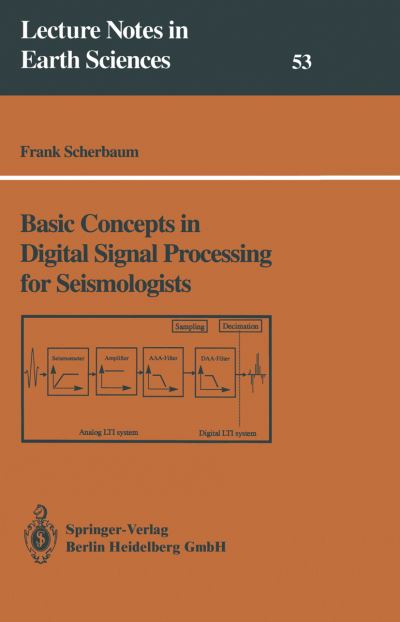
Digital signal processing has become more and more an integral part of observational seismology. While it offers unprecedented power in extracting information from seismic signals, it comes at the price of having to learn a variety of new skills. Dealing with digital seismic data requires at least a basic understanding of digital signal processing.
Taking the calculation of true ground motion as the guiding problem, this course covers the basic theory of linear systems, the design and analysis of simple digital filters, the effect of sampling and A/D conversion and an introduction to spectral analysis of digital signals. It contains a number of examples and exercises that can be reproduced using the PITSA software package (Scherbaum and Johnson 1993) or similar programs.
| ISBN: | 9783540579731 |
| Publication date: | 28th July 1994 |
| Author: | Frank Scherbaum |
| Publisher: | Springer an imprint of Springer Berlin Heidelberg |
| Format: | Paperback |
| Pagination: | 164 pages |
| Series: | Lecture Notes in Earth Sciences |
| Genres: |
Geophysics Geology, geomorphology and the lithosphere |
Digital signal processing has become more and more an integral part of observational seismology. While it offers unprecedented power in extracting information from seismic signals, it comes at the price of having to learn a variety of new skills.
Basic Concepts in Digital Signal Processing for Seismologists features in the following genres: Geophysics, Geology, geomorphology and the lithosphere
Paperback. Not Available.
Basic Concepts in Digital Signal Processing for Seismologists was written by Frank Scherbaum and published by Springer an imprint of Springer Berlin Heidelberg
Basic Concepts in Digital Signal Processing for Seismologists has 164 pages
Yes it is part of Lecture Notes in Earth Sciences series