

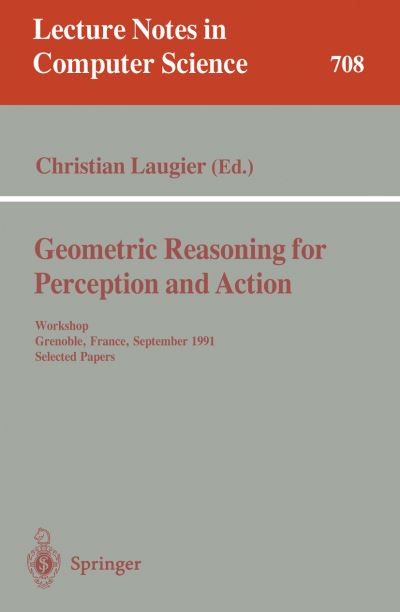
Geometry is a powerful tool to solve a great number of problems in robotics and computer vision. Impressive results have been obtained in these fields in the last decade. It is a new challenge to solve problems of the actual world which require the ability to reason about uncertainty and complex motion constraints by combining geometric, kinematic, and dynamic characteristics.
A necessary step is to develop appropriate geometric reasoning techniques with reasonable computational complexity. This volume is based on a workshop held in Grenoble, France,in September 1991. It contains selected contributions on several important areas in the field of robotics and computer vision.
The four chapters cover the following areas: - motion planning with kinematic and dynamic constraints, - motion planning and control in the presence of uncertainty, - geometric problems related to visual perception, -numerical problems linked to the implementation of practical algorithms for visual perception.
| ISBN: | 9783540571322 |
| Publication date: | 30th August 1993 |
| Author: | Christian Laugier |
| Publisher: | Springer an imprint of Springer Berlin Heidelberg |
| Format: | Paperback |
| Pagination: | 288 pages |
| Series: | Lecture Notes in Computer Science |
| Genres: |
Automatic control engineering Computer vision Graphics programming Artificial intelligence Management and management techniques Engineering: general |
Geometry is a powerful tool to solve a great number of problems in robotics and computer vision. Impressive results have been obtained in these fields in the last decade.
Geometric Reasoning for Perception and Action features in the following genres: Automatic control engineering, Computer vision, Graphics programming, Artificial intelligence, Management and management techniques, Engineering: general
Paperback. Not Available.
Geometric Reasoning for Perception and Action was written by Christian Laugier and published by Springer an imprint of Springer Berlin Heidelberg
Geometric Reasoning for Perception and Action has 288 pages
Yes it is part of Lecture Notes in Computer Science series