

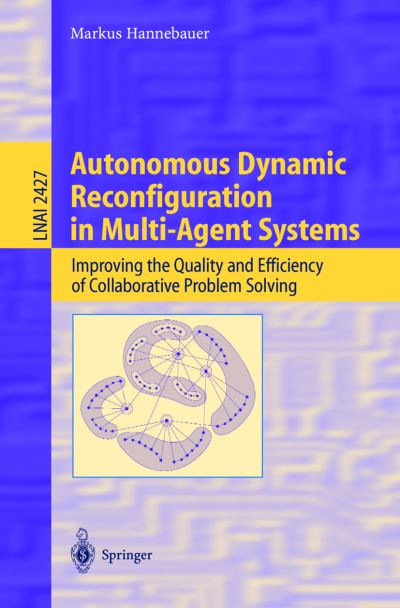
High communication efforts and poor problem solving results due to restricted overview are two central issues in collaborative problem solving. This work addresses these issues by introducing the processes of agent melting and agent splitting that enable individual problem solving agents to continually and autonomously reconfigure and adapt themselves to the particular problem to be solved.
The author provides a sound theoretical foundation of collaborative problem solving itself and introduces various new design concepts and techniques to improve its quality and efficiency, such as the multi-phase agreement finding protocol for external problem solving, the composable belief-desire-intention agent architecture, and the distribution-aware constraint specification architecture for internal problem solving.
The practical relevance and applicability of the concepts and techniques provided are demonstrated by using medical appointment scheduling as a case study.
| ISBN: | 9783540443124 |
| Publication date: | 6th November 2002 |
| Author: | Markus Hannebauer |
| Publisher: | Springer an imprint of Springer Berlin Heidelberg |
| Format: | Paperback |
| Pagination: | 284 pages |
| Series: | Lecture Notes in Computer Science |
| Genres: |
Artificial intelligence Business mathematics and systems Digital and information technologies: social and ethical aspects Network hardware Compilers and interpreters Applied computing Business applications |
High communication efforts and poor problem solving results due to restricted overview are two central issues in collaborative problem solving. This work addresses these issues by introducing the processes of agent melting and agent splitting that enable individual problem solving agents to continually and autonomously reconfigure and adapt themselves to the particular problem to be solved.
Autonomous Dynamic Reconfiguration in Multi-Agent Systems features in the following genres: Artificial intelligence, Business mathematics and systems, Digital and information technologies: social and ethical aspects, Network hardware, Compilers and interpreters, Applied computing, Business applications
Paperback. Not Available.
Autonomous Dynamic Reconfiguration in Multi-Agent Systems was written by Markus Hannebauer and published by Springer an imprint of Springer Berlin Heidelberg
Autonomous Dynamic Reconfiguration in Multi-Agent Systems has 284 pages
Yes it is part of Lecture Notes in Computer Science series