

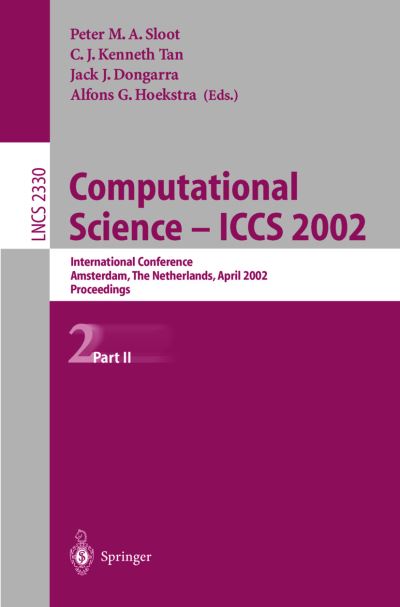
Computational Science is the scienti?c discipline that aims at the development and understanding of new computational methods and techniques to model and simulate complex systems. The area of application includes natural systems - such as biology, envir- mental and geo-sciences, physics, and chemistry - and synthetic systems such as electronics and ?nancial and economic systems. The discipline is a bridge b- ween 'classical' computer science - logic, complexity, architecture, algorithms - mathematics, and the use of computers in the aforementioned areas.
The relevance for society stems from the numerous challenges that exist in the various science and engineering disciplines, which can be tackled by advances made in this ?eld. For instance new models and methods to study environmental issues like the quality of air, water, and soil, and weather and climate predictions through simulations, as well as the simulation-supported development of cars, airplanes, and medical and transport systems etc.
Paraphrasing R. Kenway (R.D. Kenway, Contemporary Physics. 1994): 'There is an important message to scientists, politicians, and industrialists: in the future science, the best industrial design and manufacture, the greatest medical progress, and the most accurate environmental monitoring and forecasting will be done by countries that most rapidly exploit the full potential ofcomputational science'.
Nowadays we have access to high-end computer architectures and a large range of computing environments, mainly as a consequence of the enormous s- mulus from the various international programs on advanced computing, e.g.
| ISBN: | 9783540435938 |
| Publication date: | 12th April 2002 |
| Author: | ICCS 2002 Conference, Peter Sloot |
| Publisher: | Springer an imprint of Springer Berlin Heidelberg |
| Format: | Paperback |
| Pagination: | 1115 pages |
| Series: | Lecture Notes in Computer Science |
| Genres: |
Mathematical theory of computation Maths for computer scientists Numerical analysis Mathematical physics Network hardware Software Engineering |
Computational Science is the scienti?c discipline that aims at the development and understanding of new computational methods and techniques to model and simulate complex systems. The area of application includes natural systems - such as biology, envir- mental and geo-sciences, physics, and chemistry - and synthetic systems such as electronics and ?nancial and economic systems.
Computational Science - ICCS 2002 features in the following genres: Mathematical theory of computation, Maths for computer scientists, Numerical analysis, Mathematical physics, Network hardware, Software Engineering
Paperback. Not Available.
Computational Science - ICCS 2002 was written by ICCS 2002 Conference, Peter Sloot and published by Springer an imprint of Springer Berlin Heidelberg
Computational Science - ICCS 2002 has 1,115 pages
Yes it is part of Lecture Notes in Computer Science series