

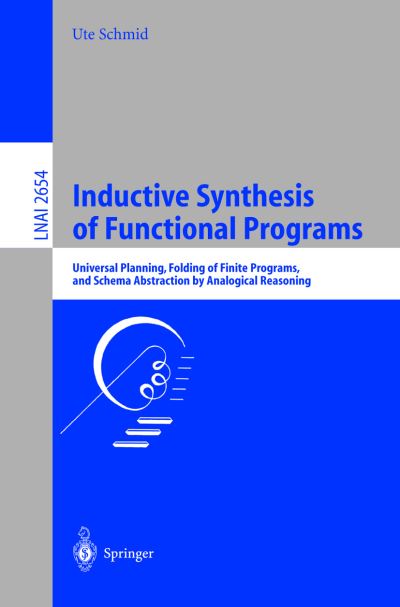
Because of its promise to support human programmers in developing correct and efficient program code and in reasoning about programs, automatic program synthesis has attracted the attention of researchers and professionals since the 1970s.
This book focusses on inductive program synthesis, and especially on the induction of recursive functions; it is organized into three parts on planning, inductive program synthesis, and analogical problem solving and learning. Besides methodological issues in inductive program synthesis, emphasis is placed on its applications to control rule learning for planning. Furthermore, relations to problem solving and learning in cognitive psychology are discussed.
| ISBN: | 9783540401742 |
| Publication date: | 21st August 2003 |
| Author: | U Schmid |
| Publisher: | Springer an imprint of Springer Berlin Heidelberg |
| Format: | Paperback |
| Pagination: | 398 pages |
| Series: | Lecture Notes in Computer Science |
| Genres: |
Artificial intelligence Software Engineering Mathematical theory of computation Interdisciplinary studies Computer programming / software engineering |
Because of its promise to support human programmers in developing correct and efficient program code and in reasoning about programs, automatic program synthesis has attracted the attention of researchers and professionals since the 1970s. This book focusses on inductive program synthesis, and especially on the induction of recursive functions; it is organized into three parts on planning, inductive program synthesis, and analogical problem solving and learning.
Inductive Synthesis of Functional Programs features in the following genres: Artificial intelligence, Software Engineering, Mathematical theory of computation, Interdisciplinary studies, Computer programming / software engineering
Paperback. Not Available.
Inductive Synthesis of Functional Programs was written by U Schmid and published by Springer an imprint of Springer Berlin Heidelberg
Inductive Synthesis of Functional Programs has 398 pages
Yes it is part of Lecture Notes in Computer Science series