

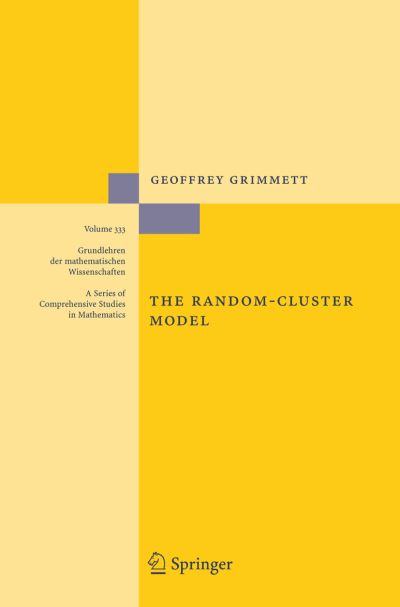
Therandom-clustermodelwasinventedbyCees[Kees]FortuinandPietKasteleyn around 1969 as a uni?cation of percolation, Ising, and Potts models, and as an extrapolation of electrical networks. Their original motivation was to harmonize the series and parallel laws satis?ed by such systems. In so doing, they initiated a study in stochastic geometry which has exhibited beautiful structure in its own right, and which has become a central tool in the pursuit of one of the oldest challenges of classical statistical mechanics, namely to model and analyse the ferromagnet and especially its phase transition.
The importance of the model for probability and statistical mechanics was not fully recognized until the late 1980s. There are two reasons for this period of dormancy. Although the early publications of 1969-1972 contained many of the basic properties of the model, the emphasis placed there upon combinatorial aspects may have obscured its potential for applications.
In addition, many of the geometrical arguments necessary for studying the model were not known prior to 1980, but were developed during the 'decade of percolation' that began 1 then. In 1980 was published the proof that p = for bond percolation on the c 2 square lattice, and this was followed soon by Harry Kesten's monograph on t- dimensionalpercolation. Percolationmovedintohigherdimensionsaround1986, and many of the mathematical issues of the day were resolved by 1989.
Interest in the random-cluster model as a tool for studying the Ising/Potts models was rekindled around 1987.
| ISBN: | 9783540328902 |
| Publication date: | 13th June 2006 |
| Author: | Geoffrey Grimmett |
| Publisher: | Springer an imprint of Springer Berlin Heidelberg |
| Format: | Hardback |
| Pagination: | 377 pages |
| Series: | Grundlehren Der Mathematischen Wissenschaften |
| Genres: |
Probability and statistics Stochastics Mathematical physics |
Therandom-clustermodelwasinventedbyCees[Kees]FortuinandPietKasteleyn around 1969 as a uni?cation of percolation, Ising, and Potts models, and as an extrapolation of electrical networks. Their original motivation was to harmonize the series and parallel laws satis?ed by such systems.
The Random-Cluster Model features in the following genres: Probability and statistics, Stochastics, Mathematical physics
Hardback. Not Available.
The Random-Cluster Model was written by Geoffrey Grimmett and published by Springer an imprint of Springer Berlin Heidelberg
The Random-Cluster Model has 377 pages
Yes it is part of Grundlehren Der Mathematischen Wissenschaften series