

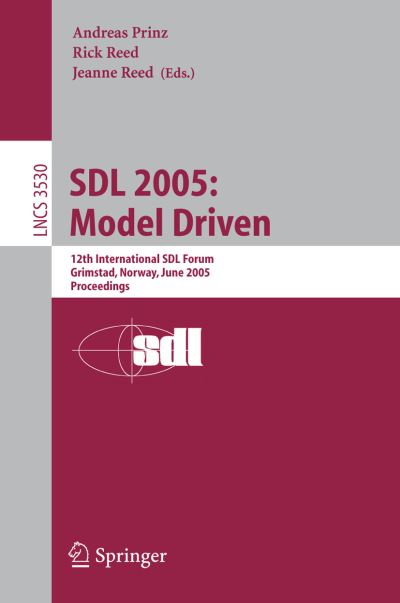
This volume contains the papers presented at the 12th SDL Forum, Grimstad, Norway. The SDL Forum was ?rst held in 1982, and then every two years from 1985. Initially the Forum was concerned only with the Speci?cation and Description Language that was ?rst standardized in the 1976 Orange Book of the Inter- tional Telecommunication Union (ITU).
Since then, many developments took place and the language has undergone several changes. However, the main underlying paradigm has survived, and it is the reason for the success of the Speci?cation and Description Language in many projects. This paradigm is based on the following important principles of distributed - plications: Communication: large systems tend to be described using smaller parts that communicate with each other; State: the systems are described on the basis of an explicit notion of state; State change: the behavior of the system is described in terms of (local) changes of the state.
The original language is not the only representative for this kind of paradigm, so the scope of the SDL Forum was extended quite soon after the ?rst few events to also include other ITU standardized languages of the same family, such as MSC, ASN.1 and TTCN. This led to the current scope of System Design Languages coveringallstagesofthedevelopmentprocessincludinginparticularSDL,MSC, UML, ASN.1, eODL, TTCN, and URN. The focus is clearly on the advantages to users, and how to get from these languages the same advantage given by the ITU Speci?cation and Description Language: code generation from high-level speci?cations.
| ISBN: | 9783540266129 |
| Publication date: | 9th June 2005 |
| Author: | Andreas Prinz, Rick Reed, Jeanne Reed |
| Publisher: | Springer an imprint of Springer Berlin Heidelberg |
| Format: | Paperback |
| Pagination: | 364 pages |
| Series: | Lecture Notes in Computer Science |
| Genres: |
Computer hardware Software Engineering Mathematical theory of computation Business mathematics and systems |
This volume contains the papers presented at the 12th SDL Forum, Grimstad, Norway. The SDL Forum was ?rst held in 1982, and then every two years from 1985.
SDL 2005: Model Driven Computer Communication Networks and Telecommunications features in the following genres: Computer hardware, Software Engineering, Mathematical theory of computation, Business mathematics and systems
Paperback. Not Available.
SDL 2005: Model Driven Computer Communication Networks and Telecommunications was written by Andreas Prinz, Rick Reed, Jeanne Reed and published by Springer an imprint of Springer Berlin Heidelberg
SDL 2005: Model Driven Computer Communication Networks and Telecommunications has 364 pages
Yes it is part of Lecture Notes in Computer Science series