

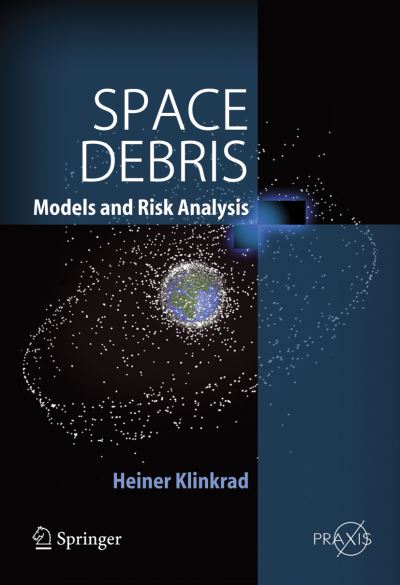
In Space Debris Models and Risk Analysis the authors will provide the reader with a comprehensive background to understand the various sources of space debris, and to assess associated risks due to the current and future space debris environment. Apart from the non-trackable objects produced by historic on-orbit fragmentation events, several other sources of space debris will be outlined. Models will be described to allow the generation and propagation of the different debris families and permit the assessment of the associated collision risk on representative target orbits for present and future conditions. Using traffic models and possible mitigation practices, the future evolution of the space debris environment will be forecast. For large-size, trackable objects methods will be described for conjunction event predictions and related risk assessments. For hazardous re-entry objects, procedures will be outlined to enable the prediction of re-entry times and likely impact areas, to assess uncertainties in these factors, and to quantify the risk due to ground impact. Models will also be described for meteoroids, which prevail over space debris at small particle sizes.
| ISBN: | 9783540254485 |
| Publication date: | 5th January 2006 |
| Author: | Heiner Klinkrad |
| Publisher: | Springer an imprint of Springer Berlin Heidelberg |
| Format: | Hardback |
| Pagination: | 430 pages |
| Series: | Springer-Praxis Books in Astronautical Engineering |
| Genres: |
Aerospace and aviation technology Astronautics Security and fire alarm systems Automotive technology and trades Probability and statistics Solar system: the Sun and planets Applied physics |
In Space Debris Models and Risk Analysis the authors will provide the reader with a comprehensive background to understand the various sources of space debris, and to assess associated risks due to the current and future space debris environment. Apart from the non-trackable objects produced by historic on-orbit fragmentation events, several other sources of space debris will be outlined. Models will be described to allow the generation and propagation of the different debris families and permit the assessment of the associated collision risk on representative target orbits for present and future conditions. Using traffic models and possible mitigation practices, the future evolution of the space debris environment will be forecast. For large-size, trackable objects methods will be described for conjunction event predictions and related risk assessments. For hazardous re-entry objects, procedures will be outlined to enable the prediction of re-entry times and likely impact areas, to assess uncertainties in these factors, and to quantify the risk due to ground impact. Models will also be described for meteoroids, which prevail over space debris at small particle sizes.
Space Debris features in the following genres: Aerospace and aviation technology, Astronautics, Applied physics, Solar system: the Sun and planets, Automotive technology and trades, Security and fire alarm systems, Probability and statistics
Space Debris is available in Hardback
Space Debris was written by Heiner Klinkrad and published by Springer an imprint of Springer Berlin Heidelberg
Space Debris has 430 pages
Yes it is part of Springer-Praxis Books in Astronautical Engineering series
£236.70