

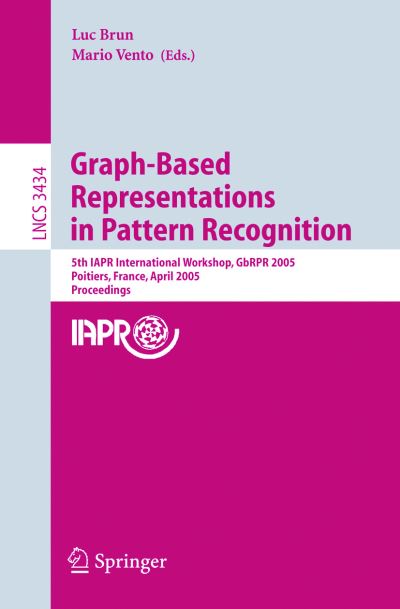
Many vision problems have to deal with di?erent entities (regions, lines, line junctions, etc.) and their relationships. These entities together with their re- tionships may be encoded using graphs or hypergraphs. The structural inf- mation encoded by graphs allows computer vision algorithms to address both the features of the di?erent entities and the structural or topological relati- ships between them.
Moreover, turning a computer vision problem into a graph problem allows one to access the full arsenal of graph algorithms developed in computer science. The Technical Committee (TC15, http://www.iapr.org/tcs.html) of the IAPR (International Association for Pattern Recognition) has been funded in order to federate and to encourage research work in these ?elds. Among its - tivities, TC15 encourages the organization of special graph sessions at many computer vision conferences and organizes the biennial workshop GbR.
While being designed within a speci?c framework, the graph algorithms developed for computer vision and pattern recognition tasks often share constraints and goals with those developed in other research ?elds such as data mining, robotics and discrete geometry. The TC15 community is thus not closed in its research ?elds but on the contrary is open to interchanges with other groups/communities.
| ISBN: | 9783540252702 |
| Publication date: | 23rd March 2005 |
| Author: | GbRPR Workshop, Luc Brun, Mario Vento, International Association for Pattern Recognition |
| Publisher: | Springer an imprint of Springer Berlin Heidelberg |
| Format: | Paperback |
| Pagination: | 384 pages |
| Series: | Lecture Notes in Computer Science |
| Genres: |
Pattern recognition Computer vision Maths for computer scientists Discrete mathematics Graphics programming Databases |
Many vision problems have to deal with di?erent entities (regions, lines, line junctions, etc.) and their relationships. These entities together with their re- tionships may be encoded using graphs or hypergraphs.
Graph-Based Representations in Pattern Recognition features in the following genres: Pattern recognition, Computer vision, Maths for computer scientists, Discrete mathematics, Graphics programming, Databases
Paperback. Not Available.
Graph-Based Representations in Pattern Recognition was written by GbRPR Workshop, Luc Brun, Mario Vento, International Association for Pattern Recognition and published by Springer an imprint of Springer Berlin Heidelberg
Graph-Based Representations in Pattern Recognition has 384 pages
Yes it is part of Lecture Notes in Computer Science series