

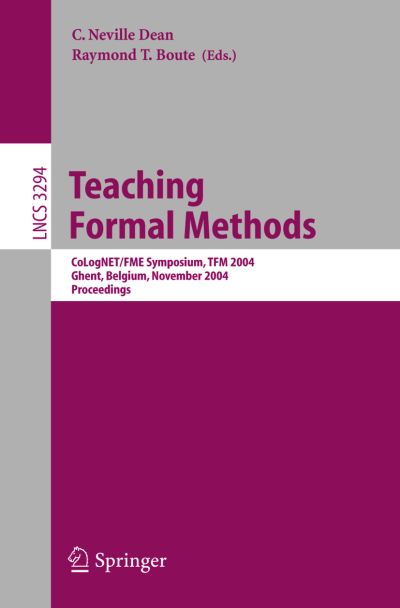
"Professional engineers can often be distinguished from other designers by the engineers' ability to use mathematical models to describe and 1 analyze their products." This observation by Parnas describes the de facto professional standards in all classical engineering disciplines (civil, mechanical, electrical, etc.). Unf- tunately, it is in sharp contrast with current (industrial) practice in software design, where mathematical models are hardly used at all, even by those who, 2 in Holloway's words "aspire to be engineers." The rare exceptions are certain critical applications, where mathematical techniques are used under the general name formal methods.
Yet,thesamecharacteristicsthatmakeformalmethodsanecessityincritical applicationsmakethemalsoadvantageousineverydaysoftwaredesignatvarious levels from design e?ciency to software quality. Why, then, is education failing with respect to formal methods? - failing to convince students, academics and practitioners alike that formal methods are truly pragmatic; - failing to overcome a phobia of formality and mathematics; - failing to provide students with the basic skills and understanding required toadoptamoremathematicalandlogicalapproachtosoftwaredevelopment.
Until education takes these failings seriously, formal methods will be an obscure byway in software engineering, which in turn will remain severely impoverished as a result.
| ISBN: | 9783540236115 |
| Publication date: | 17th November 2004 |
| Author: | TFM 2004, Neville Dean, R T Boute |
| Publisher: | Springer an imprint of Springer Berlin Heidelberg |
| Format: | Paperback |
| Pagination: | 248 pages |
| Series: | Lecture Notes in Computer Science |
| Genres: |
Mathematical theory of computation Educational equipment and technology, computer-aided learning (CAL) Software Engineering Databases |
Unf- tunately, it is in sharp contrast with current (industrial) practice in software design, where mathematical models are hardly used at all, even by those who, 2 in Holloway's words "aspire to be engineers." The rare exceptions are certain critical applications, where mathematical techniques are used under the general name formal methods. Yet,thesamecharacteristicsthatmakeformalmethodsanecessityincritical applicationsmakethemalsoadvantageousineverydaysoftwaredesignatvarious levels from design e?ciency to software quality.
Teaching Formal Methods features in the following genres: Mathematical theory of computation, Educational equipment and technology, computer-aided learning (CAL), Software Engineering, Databases
Paperback. Not Available.
Teaching Formal Methods was written by TFM 2004, Neville Dean, R T Boute and published by Springer an imprint of Springer Berlin Heidelberg
Teaching Formal Methods has 248 pages
Yes it is part of Lecture Notes in Computer Science series