

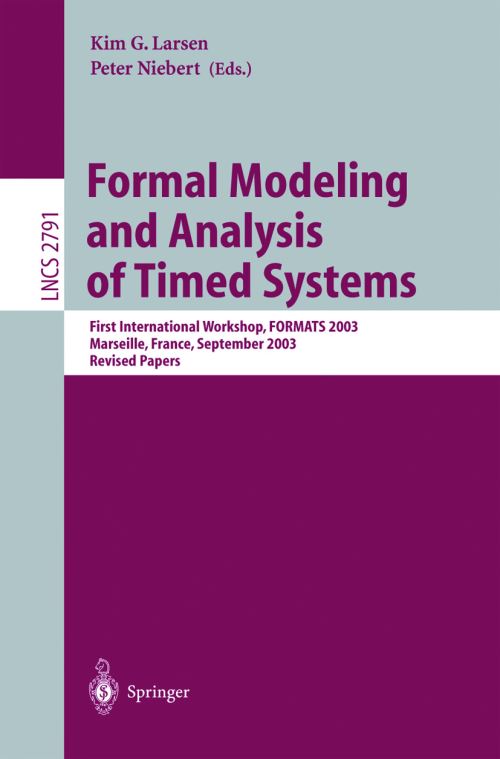
This book constitutes the thoroughly refereed post-proceedings of the First International Workshop on Formal Modeling and Analysis of Timed Systems, FORMATS 2003, held in Marseille, France in September 2003.
The 19 revised full papers presented together with an invited paper and the abstracts of two invited talks were carefully selected from 36 submissions during two rounds of reviewing and improvement. All current aspects of formal method for modeling and analyzing timed systems are addressed; among the timed systems dealt with are timed automata, timed Petri nets, max-plus algebras, real-time systems, discrete time systems, timed languages, and real-time operating systems.
| ISBN: | 9783540216711 |
| Publication date: | 8th April 2004 |
| Author: | FORMATS Conference, K G Larsen, Peter Niebert |
| Publisher: | Springer an imprint of Springer Berlin Heidelberg |
| Format: | Paperback |
| Pagination: | 280 pages |
| Series: | Lecture Notes in Computer Science |
| Genres: |
Applied mathematics Expert systems / knowledge-based systems Compilers and interpreters Software Engineering Mathematical theory of computation |
This book constitutes the thoroughly refereed post-proceedings of the First International Workshop on Formal Modeling and Analysis of Timed Systems, FORMATS 2003, held in Marseille, France in September 2003. The 19 revised full papers presented together with an invited paper and the abstracts of two invited talks were carefully selected from 36 submissions during two rounds of reviewing and improvement.
Formal Modeling and Analysis of Timed Systems features in the following genres: Applied mathematics, Expert systems / knowledge-based systems, Compilers and interpreters, Software Engineering, Mathematical theory of computation
Paperback. Not Available.
Formal Modeling and Analysis of Timed Systems was written by FORMATS Conference, K G Larsen, Peter Niebert and published by Springer an imprint of Springer Berlin Heidelberg
Formal Modeling and Analysis of Timed Systems has 280 pages
Yes it is part of Lecture Notes in Computer Science series