

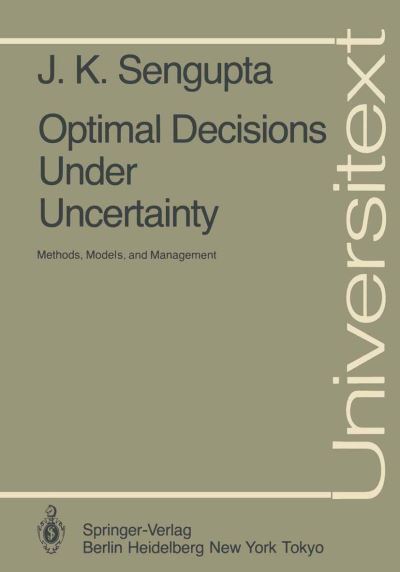
Understanding the stochastic enviornment is as much important to the manager as to the economist. From production and marketing to financial management, a manager has to assess various costs imposed by uncertainty. The economist analyzes the role of incomplete and too often imperfect information structures on the optimal decisions made by a firm.
The need for understanding the role of uncertainty in quantitative decision models, both in economics and management science provide the basic motivation of this monograph. The stochastic environment is analyzed here in terms of the following specific models of optimization: linear and quadratic models, linear programming, control theory and dynamic programming. Uncertainty is introduced here through the para- meters, the constraints, and the objective function and its impact evaluated.
Specifically recent developments in applied research are emphasized, so that they can help the decision-maker arrive at a solution which has some desirable charac- teristics like robustness, stability and cautiousness. Mathematical treatment is kept at a fairly elementary level and applied as- pects are emphasized much more than theory. Moreover, an attempt is made to in- corporate the economic theory of uncertainty into the stochastic theory of opera- tions research.
Methods of optimal decision rules illustrated he re are applicable in three broad areas: (a) applied economic models in resource allocation and economic planning, (b) operations research models involving portfolio analysis and stochastic linear programming and (c) systems science models in stochastic control and adaptive behavior.
| ISBN: | 9783540150329 |
| Publication date: | 1st January 1985 |
| Author: | JK Sengupta |
| Publisher: | Springer an imprint of Springer Berlin Heidelberg |
| Format: | Paperback |
| Pagination: | 286 pages |
| Series: | Universitext |
| Genres: |
Operational research Management decision making Economic theory and philosophy |
Understanding the stochastic enviornment is as much important to the manager as to the economist. From production and marketing to financial management, a manager has to assess various costs imposed by uncertainty.
Optimal Decisions Under Uncertainty features in the following genres: Operational research, Management decision making, Economic theory and philosophy
Paperback. Not Available.
Optimal Decisions Under Uncertainty was written by JK Sengupta and published by Springer an imprint of Springer Berlin Heidelberg
Optimal Decisions Under Uncertainty has 286 pages
Yes it is part of Universitext series