

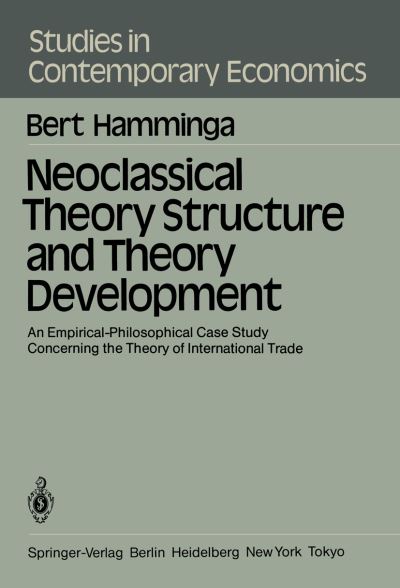
There are quite a lot of recent books on the methodology of economics, but all proceed from one or more of the following three fundamental assumptions: 1) Meta-apriorism: it is a priori believed that the results of the philosophy of science of the past decades, associated with the names of Popper, Kuhn and Lakatos, yield conceptual frameworks that can be used to describe the product of the economist's endeavours. 2) Synchronism: it is believed that the inspection of a "theory" of economics, the presentation of some economic belief at a point in time, reveals its logical structure and ipso facto the "method" by which the "theory" is constructed. 3) CreduZity: it is believed that what economists themselves say on their own methods is true, or at least of primary relevance.
In this book, I endeavour to show that these assumptions are false. First, the philosophies of science by Popper, Kuhn and Lakatos did not succeed in constructing a conceptual framework capable of describing theory development in economics. Secondly, this can only be seen as soon as not Zogic but history is taken to be the referee judging the adequacy of metatheories (diachronism).
Thirdly the results of metaempiricaZ (not-meta-aprioristic), diachronic (not-synchronic) research reveals that even economists themselves turn out frequently to have inadequate metatheories upon which it is dangerous to rely (suspicion instead of credulity) .
| ISBN: | 9783540128168 |
| Publication date: | 1st August 1983 |
| Author: | B Hamminga |
| Publisher: | Springer an imprint of Springer Berlin Heidelberg |
| Format: | Paperback |
| Pagination: | 176 pages |
| Series: | Studies in Contemporary Economics |
| Genres: |
International economics |
In this book, I endeavour to show that these assumptions are false. First, the philosophies of science by Popper, Kuhn and Lakatos did not succeed in constructing a conceptual framework capable of describing theory development in economics.
Neoclassical Theory Structure and Theory Development features in the following genres: International economics
Paperback. Not Available.
Neoclassical Theory Structure and Theory Development was written by B Hamminga and published by Springer an imprint of Springer Berlin Heidelberg
Neoclassical Theory Structure and Theory Development has 176 pages
Yes it is part of Studies in Contemporary Economics series