

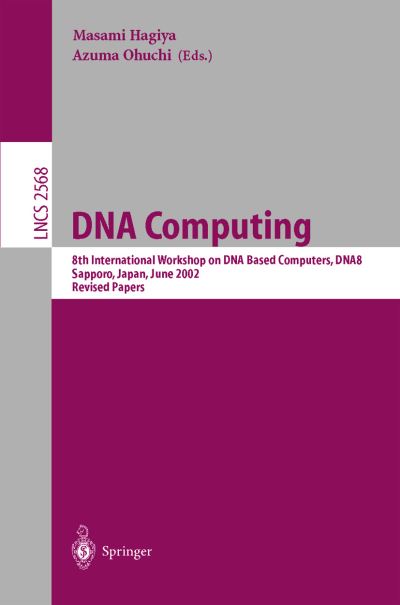
Biomolecular computing has emerged as an interdisciplinary ?eld that draws - gether chemistry, computer science, mathematics, molecular biology, and physics. Our knowledge on DNA nanotechnology and biomolecular computing increases exponentially with every passing year. The international meeting on DNA Based Computers has been a forum where scientists with di?erent backgrounds, yet sharing a common interest in biomolecular computing, meet and present their latest results.
Continuing this tradition, the 8th International Meeting on DNA Based Computers (DNA8) focuses on the current theoretical and experimental results with the greatest impact. Papers and poster presentations were sought in all areas that relate to b- molecular computing, including (but not restricted to): algorithms and appli- tions, analysis of laboratory techniques/theoretical models, computational p- cesses in vitro and in vivo, DNA-computing-based biotechnological applications, DNA devices, error evaluation and correction, in vitro evolution, models of biomolecular computing (using DNA and/or other molecules), molecular - sign, nucleic acid chemistry, and simulation tools.
Papers and posters with new experimental results were particularly encouraged. Authors who wished their work to be considered for either oral or poster presentation were asked to select from one of two submission "tracks": - Track A - Full Paper - Track B - One-Page Abstract For authors with late-breaking results, or who were submitting their manuscript to a scienti?c journal, a one-page abstract, rather than a full paper, could be submitted in Track B.
Authors could (optionally) include a preprint of their full paper, for consideration only by the program committee.
| ISBN: | 9783540005315 |
| Publication date: | 5th February 2003 |
| Author: | International Workshop on DNABased Computers, Masami Hagiya, Azuma Ohuchi |
| Publisher: | Springer an imprint of Springer Berlin Heidelberg |
| Format: | Paperback |
| Pagination: | 336 pages |
| Series: | Lecture Notes in Computer Science |
| Genres: |
Mathematical logic Computational biology / bioinformatics Algorithms and data structures Mathematical theory of computation Artificial intelligence Mathematical foundations |
Biomolecular computing has emerged as an interdisciplinary ?eld that draws - gether chemistry, computer science, mathematics, molecular biology, and physics. Our knowledge on DNA nanotechnology and biomolecular computing increases exponentially with every passing year.
DNA Computing features in the following genres: Mathematical logic, Computational biology / bioinformatics, Algorithms and data structures, Mathematical theory of computation, Artificial intelligence, Mathematical foundations
Paperback. Not Available.
DNA Computing was written by International Workshop on DNABased Computers, Masami Hagiya, Azuma Ohuchi and published by Springer an imprint of Springer Berlin Heidelberg
DNA Computing has 336 pages
Yes it is part of Lecture Notes in Computer Science series