

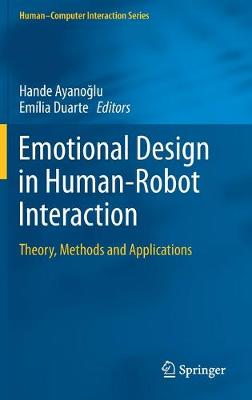
While social robots participation increases in everyday human life, their presence in diverse contexts and situations is expected. At the same point, users tend to become more demanding regarding their roles, abilities, behaviour and appearance. Thus, designers and developers are confronted with the need to design more sophisticated robots that can produce such a positive reaction from users so as to become well accepted in various cases of use.
Like this, Human-Robot Interaction has become a developing area. Emotions are an important part in human life, since they mediate the interaction with other humans, entities and/or products. In recent years, there has been an increase in the importance of emotions applied to the design field, giving rise to the so-called Emotional Design area.
In the case of Human-Robot Interaction, the emotional design can help to elicit (e.g., pleasurable) or prevent (e.g., unpleasant) emotional/affective reactions/responses. This book gives a practical introduction to emotional design in human-robot interaction and supports designers with knowledge and research tools to help them take design decisions based on a User-Centred Design approach. It should also be useful to people interested in design processes, even if not directly related to the design of social robots but, instead, to other technology-based artefacts.
The text is meant as a reference source with practical guidelines and advice for design issues.
| ISBN: | 9783319967219 |
| Publication date: | 20th September 2019 |
| Author: | Hande Ayanolu |
| Publisher: | Springer International Publishing AG |
| Format: | Hardback |
| Pagination: | 199 pages |
| Series: | Human–Computer Interaction Series |
| Genres: |
Human–computer interaction Design, Industrial and commercial arts, illustration Automatic control engineering Artificial intelligence |
While social robots participation increases in everyday human life, their presence in diverse contexts and situations is expected. At the same point, users tend to become more demanding regarding their roles, abilities, behaviour and appearance.
Emotional Design in Human-Robot Interaction features in the following genres: Human–computer interaction, Design, Industrial and commercial arts, illustration, Automatic control engineering, Artificial intelligence
Hardback. £125.99, down from the £139.99 cover price. Not Available.
Emotional Design in Human-Robot Interaction was written by Hande Ayanolu and published by Springer International Publishing AG
Emotional Design in Human-Robot Interaction has 199 pages
Yes it is part of Human–Computer Interaction Series series
£125.99, reduced from £139.99. Not Available.