

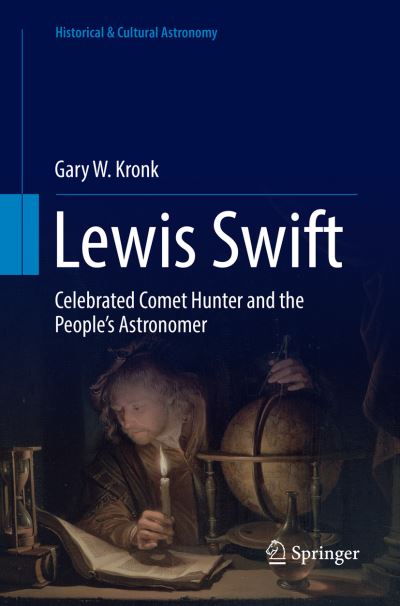
This biography covers the life of Lewis Swift (1820-1913), who discovered 13 comets and nearly 1,200 other deep sky objects. All 13 comets found by Swift now bear his name, including three periodic comets with periods of 6 years (11P/Tempel-Swift-LINEAR), 9 years (64P/Swift-Gehrels), and 133 years (109P/Swift-Tuttle).
| ISBN: | 9783319876191 |
| Publication date: | 18th August 2018 |
| Author: | Gary W Kronk |
| Publisher: | Springer an imprint of Springer International Publishing |
| Format: | Paperback |
| Pagination: | 428 pages |
| Series: | Historical & Cultural Astronomy |
| Genres: |
Astronomical observation: observatories, equipment and methods Solar system: the Sun and planets Philosophy of science History of science Physics |
This biography covers the life of Lewis Swift (1820-1913), who discovered 13 comets and nearly 1,200 other deep sky objects. All 13 comets found by Swift now bear his name, including three periodic comets with periods of 6 years (11P/Tempel-Swift-LINEAR), 9 years (64P/Swift-Gehrels), and 133 years (109P/Swift-Tuttle).Swift's enthusiasm and success as an amateur astronomer helped make him famous in the United States.
Lewis Swift features in the following genres: Astronomical observation: observatories, equipment and methods, Solar system: the Sun and planets, Philosophy of science, History of science, Physics
Paperback, Hardback. £80.99, down from the £89.99 cover price. Not Available.
Lewis Swift was written by Gary W Kronk and published by Springer an imprint of Springer International Publishing
Lewis Swift has 428 pages
Yes it is part of Historical & Cultural Astronomy series
£80.99, reduced from £89.99. Not Available.