

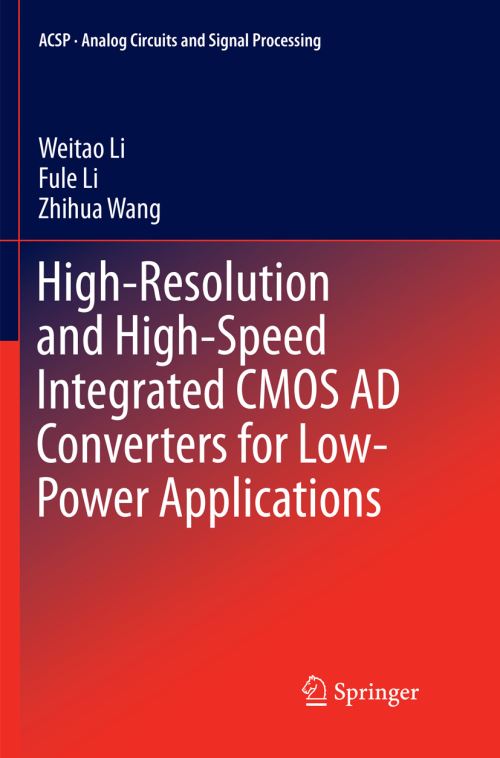
This book is a step-by-step tutorial on how to design a low-power, high-resolution (not less than 12 bit), and high-speed (not less than 200 MSps) integrated CMOS analog-to-digital (AD) converter, to respond to the challenge from the rapid growth of IoT. The discussion includes design techniques on both the system level and the circuit block level. In the architecture level, the power-efficient pipelined AD converter, the hybrid AD converter and the time-interleaved AD converter are described. In the circuit block level, the reference voltage buffer, the opamp, the comparator, and the calibration are presented. Readers designing low-power and high-performance AD converters won't want to miss this invaluable reference.
| ISBN: | 9783319872131 |
| Publication date: | 7th August 2018 |
| Author: | Weitao Li, Fule Li, Zhihua Wang |
| Publisher: | Springer an imprint of Springer International Publishing |
| Format: | Paperback |
| Pagination: | 171 pages |
| Series: | Analog Circuits and Signal Processing |
| Genres: |
Electronics: circuits and components Electronics engineering |
This book is a step-by-step tutorial on how to design a low-power, high-resolution (not less than 12 bit), and high-speed (not less than 200 MSps) integrated CMOS analog-to-digital (AD) converter, to respond to the challenge from the rapid growth of IoT. The discussion includes design techniques on both the system level and the circuit block level.
High-Resolution and High-Speed Integrated CMOS AD Converters for Low-Power Applications features in the following genres: Electronics: circuits and components, Electronics engineering
Paperback, Hardback. £89.99, down from the £99.99 cover price. Not Available.
High-Resolution and High-Speed Integrated CMOS AD Converters for Low-Power Applications was written by Weitao Li, Fule Li, Zhihua Wang and published by Springer an imprint of Springer International Publishing
High-Resolution and High-Speed Integrated CMOS AD Converters for Low-Power Applications has 171 pages
Yes it is part of Analog Circuits and Signal Processing series
£89.99, reduced from £99.99. Not Available.